



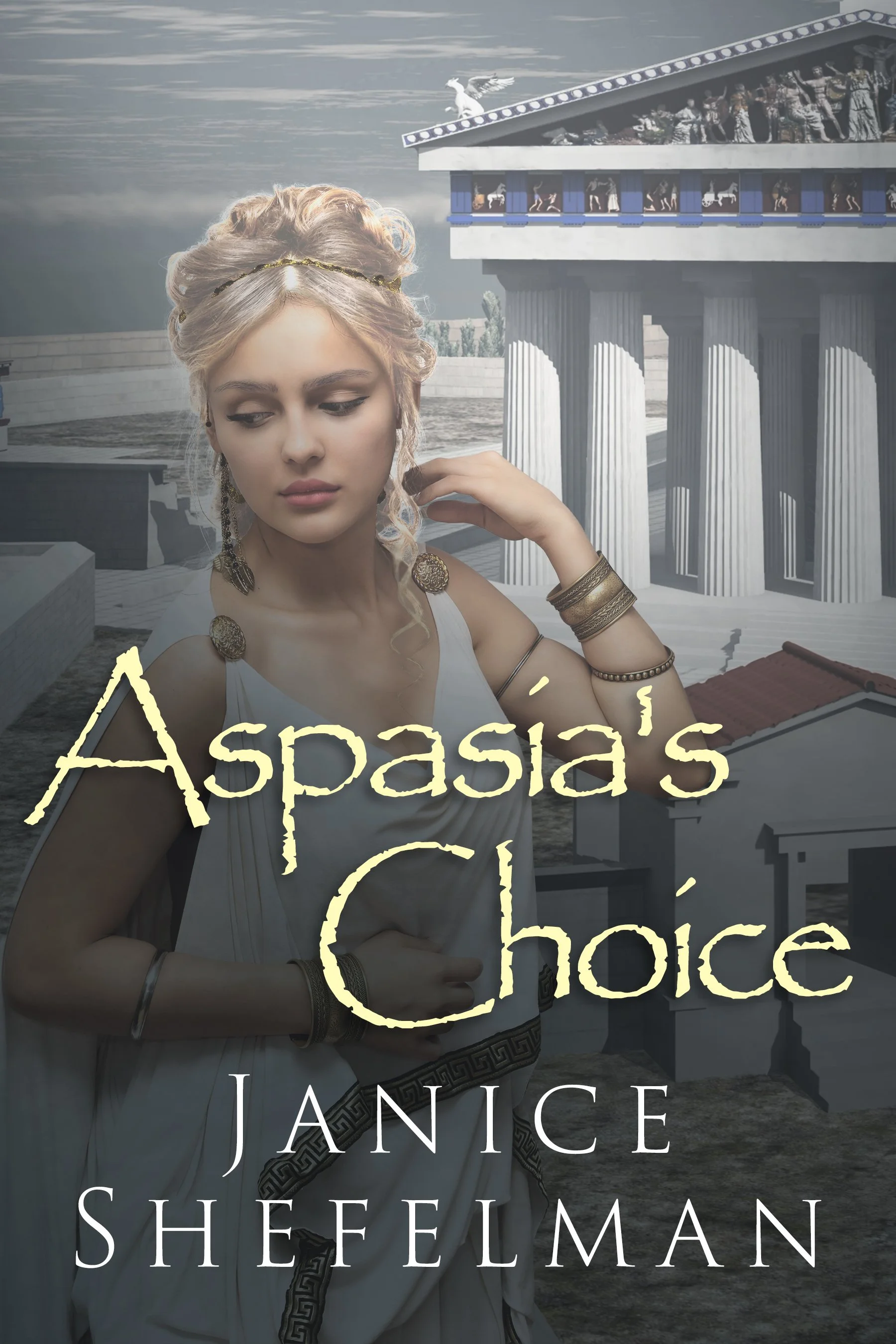
Aspasia's Choice
A forbidden love. A sacred vow. A choice that defies the laws of Athens.
In 5th century B.C. Greece, Aspasia is no ordinary girl. Educated by her worldly father in the city of Miletus, she grows up with a mind sharpened by learning—and a solemn promise. Upon his death, she vows to never live with a man unless married, never bring shame by breaking that oath.
When she’s sent to Athens to live with her sister and traditional brother-in-law, Aspasia is thrust into a society where women are confined to domestic life. But her hunger for knowledge leads her to a secret schoolroom, an unlikely friendship with a young Socrates, and a life-altering encounter with General Pericles.

As love blossoms between them, Aspasia must confront an impossible choice: honor her father’s dying wish or follow her heart in defiance of Athenian law. Her decision will shape not only her future, but her legacy.
A story of courage, intellect, and forbidden love, Aspasia’s Choice is a timeless tale of one girl’s fight to live—and love—on her own terms.
Read Aspasia’s Choice now and discover the woman behind the legend.
Excerpt from the book
Once I had a happy life in Miletus, our city beside the Aegean Sea. But no more …
My father was a successful merchant with ships that sailed across the Aegean to Athens and on across the Mediterranean as far as Egypt and Italy, even Spain. From our part of Greece he traded olive oil, wine, and wool for marble from Paros, silver from Athens, papyrus from Egypt, and more.
He was a man of the world. He learned about many different cultures from traveling to all these places. So when Tata came home, I always begged him to tell me what he had seen.
One day, when he returned from Egypt, we sat in our courtyard in the shade of the gallery – he on an ebony chair with curving legs, I on a cushion at his feet. I looked up at him. He had soft brown eyes and a trim graying beard and mustache.
“Tell me about Egyptian ladies, Tata.”
He tossed his head back. “Ahhh, those Egyptian ladies… what freedom they have! They hold their heads high, eat and drink in public, and go about their affairs in the streets, unattended and unharmed. This time one of the merchants I dealt with was a woman, and she drove a hard bargain!”
“I want to be like her, Tata.”
He chuckled. “Well, my dear Aspasia, that will take courage. This is not Egypt.”
I nodded. “So why do Greek women have to stay at home and weave?”
“Because Greek men demand it.”
“Then I will never marry any man,” I said. “I’ll be a merchant like you.”
“Or you could marry a merchant and travel with him. Meanwhile, you can come along the next time I go on a short coastal trip to Samos.”
I caught my breath and rose up on my knees. “Oh, Tata, could I really?”
He smiled. “Yes.”
But that was not to be, although I could not foresee the end of life as I knew it.
Because of Tata’s success, he, my older sister Lysandra, and I lived in a two-story row house in a wealthy neighborhood. It was built around a courtyard with a fountain and brilliant red bougainvillea climbing over the arbor.
Sadly, I cannot remember my mother, who died when I was still a baby. Tata says she was a beauty, and that I favor her. I know it is true because we have a painted stone bust of her on a pedestal in the courtyard. She had blue eyes, a pouty, full mouth, and blond curls. Tata hung her favorite necklace on the bust. It has little gold leaves hanging from a triple chain set with red garnets.
Lysandra, who just turned fifteen, is four years older than me. She assumed our mother’s role in running the household, although sometimes she became a little bossy, overdoing her mother role. She had help from Demetria, our housekeeper, who was like a grandmother to us. We called her Yia-yia. But it was Tata who saw my yearning to know about the world, so he let me go about the city as long as one of our slaves was with me.


Sed purus sem, scelerisque ac rhoncus eget, porttitor nec odio. Lorem ipsum dolor sit amet.