



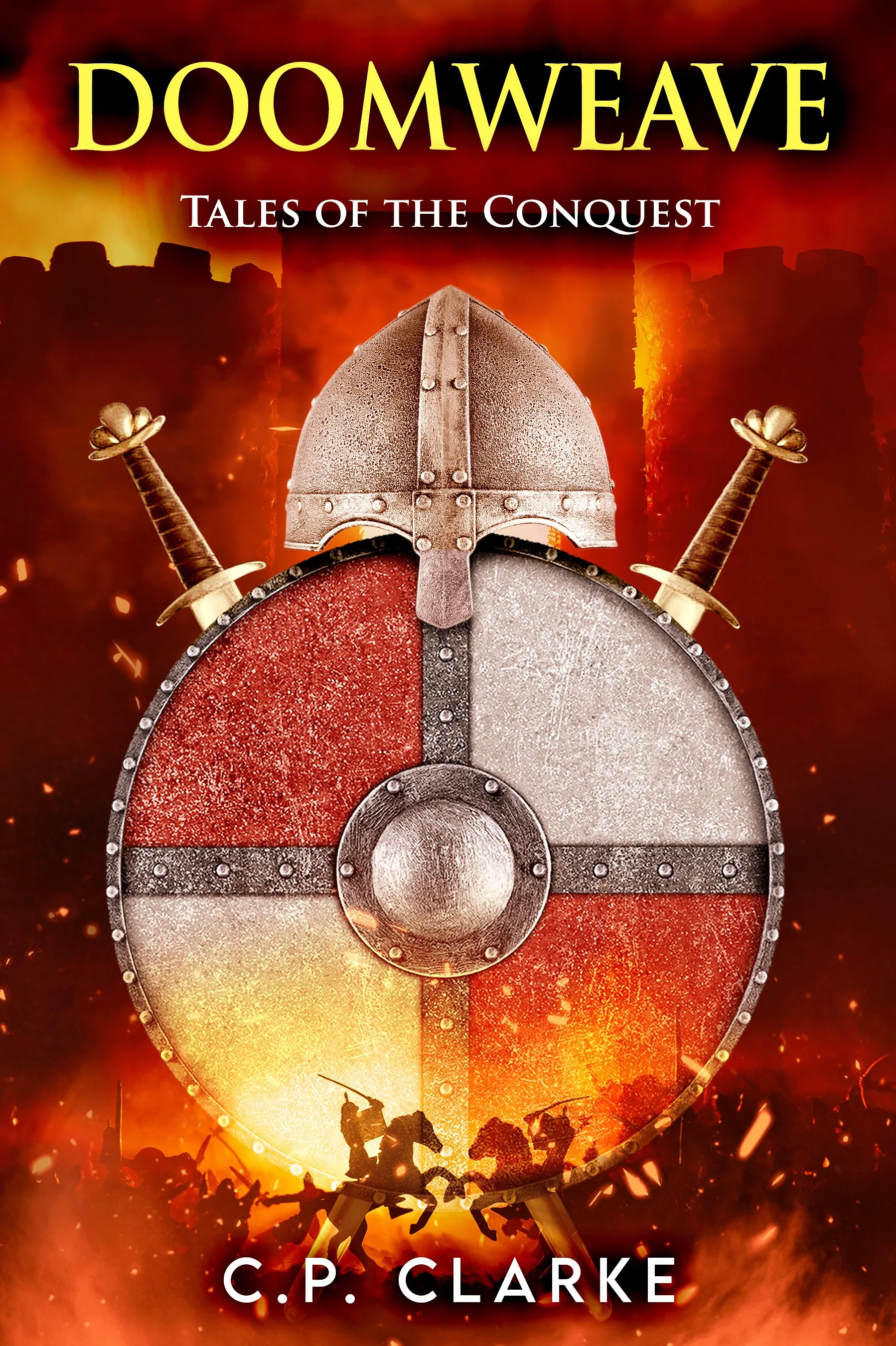
Doomweave
Three Lives. One Conquest. A Nation Forever Changed.
In the turbulent years of the Norman Conquest, Doomweave by C.P. Clarke brings the sweeping history of 11th-century England to life through the intertwined fates of three unforgettable men. Edwin, a fisherman’s son from Sussex, finds his life altered when a chance voyage places him at the side of Harold Godwinson on a journey with historic consequences. In the north, Colric survives capture by raiders, only to return home to a country on the brink of war. And Wulf, a warrior in King Harold’s court, watches the old order collapse and must choose between acceptance and resistance in the wake of Norman rule.
Spanning coastlines, kingdoms, and battlefields, Doomweave explores duty, identity, and the human cost of conquest through personal stories woven into the fabric of a nation’s defining moment.
Start reading Doomweave today and step into the lives that shaped England’s past.
Excerpt from the book
Bosham, Sussex, 1061
It was one of those ice-fast days of deepest winter. My father looked down the broad estuary to the sullen grey mass of the sea and his weather-wise eyes narrowed. He was known as the craftiest fisherman in Bosham. If there was an unusually large shoal in the narrow seas he would be there first, and if he stayed on land, looking now and then skywards and shaking his head, it was thought to be a foolish man who put to sea. This was one of those days.
He said nothing, but he brought out his nets from the cottage and began to spread them on the sand. My heart sank. I never thought to question his wisdom, but a day spent mending nets rather than heading seawards with a fair wind was hard to bear. For a moment I watched him. He seemed older today. He was limping slightly and his grey-streaked hair stirred in the quickening breeze. He worked slowly and silently, searching with care for rents in the nets.
Soon, I knew, he would bellow my name like a thunderclap and call me a lazy daydreamer, so I went to the cottage for the second great needle. Nearly at the door, I turned on a sudden to look up the shore towards the great house by the strand. How long does it take to forget?
Ten years ago, I would have seen a small figure racing towards me, shouting powerfully and struggling in vain to catch up with a huge black dog. I smiled. I would be so glad to see him, yet afraid of leaving my work. How many times in those youthful days did I run off with Wulfnoth to set traps, to play at war, to talk, to wander? Much too often, my father would say. I can see the boy now, the youngest son of Earl Godwin, the greatest man in the land after King Edward himself, and my best friend. He was strong and fair to look on and with as much energy as his dog. We had already been friends for most of our lives, though my father was uneasy about it. He said that mixing with high-born folk would put strange ideas into my head. Already, I left my work at every chance that came, and soon I would start saying that I did not want to be a fisherman.
He was right, of course. Wulfnoth talked of mind-stirring matters. He spoke of the King as if he were a neighbour. Everything he said about his father told of the making of high policy in the land, and he chattered about the royal line of Denmark as my mother did about the village oldwives. He was colour in my life, great happenings, great farings, and the doings of kings. Without him, I was left drowning in the ocean of boring chores that make up the life of a cottar. He had been my lifeline to something greater.
“Do you think to stand there all day?”

Sed purus sem, scelerisque ac rhoncus eget, porttitor nec odio. Lorem ipsum dolor sit amet.