



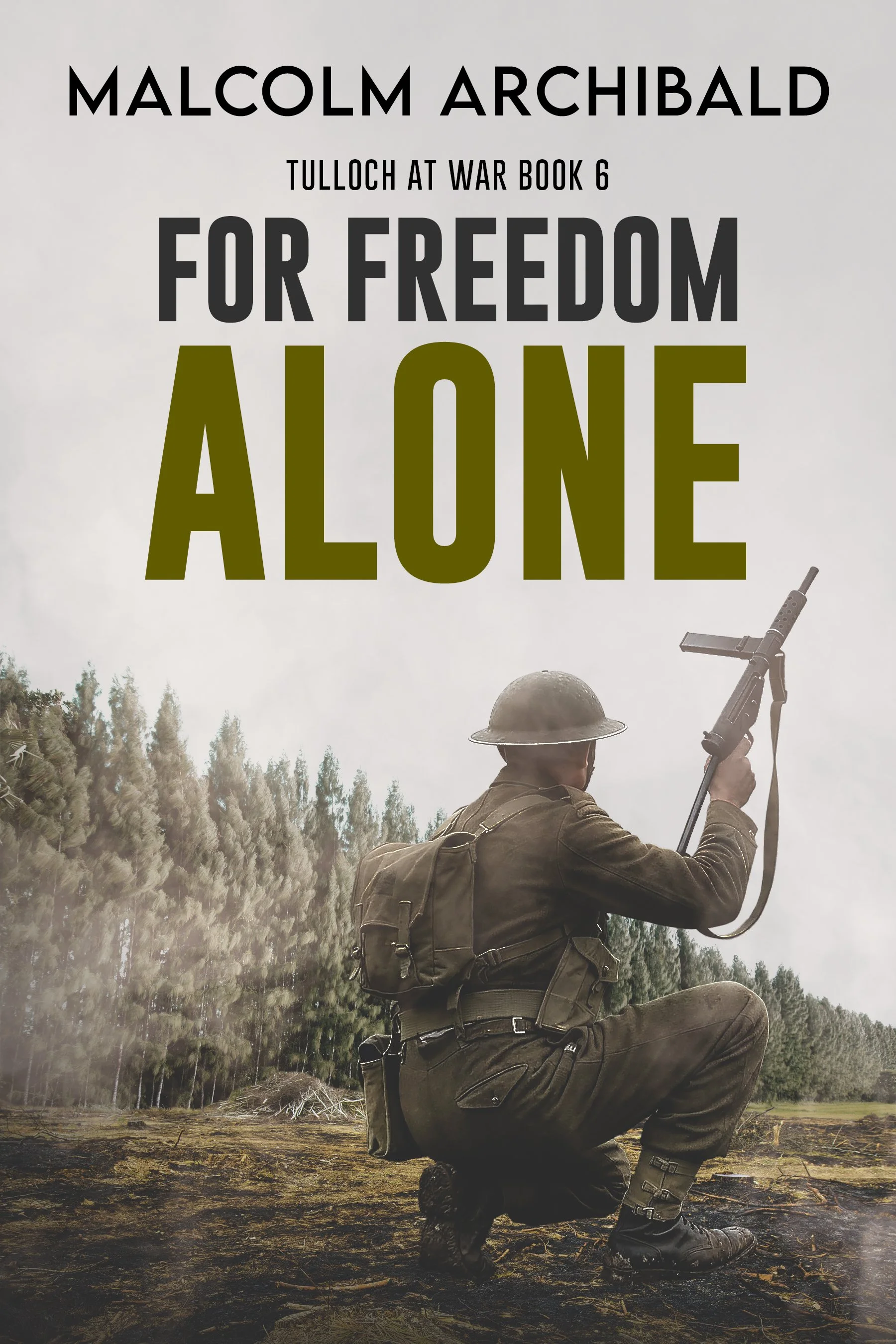
For Freedom Alone (Tulloch at War Book 6)

A Final Battle for Peace: For Freedom Alone
Autumn 1944. As the war in Europe enters its final, brutal chapter, Major Tulloch and the Lothian Rifles advance into the heart of enemy territory with the 51st Highland Division. Haunted by what they've seen and hardened by years of combat, the battalion must now face the forests, fortifications, and fierce resistance of a crumbling but desperate enemy.
A new officer, Captain Lennox, joins the ranks—fluent in German, fearless under fire, and under suspicion. As tensions rise and casualties mount, Tulloch must weigh trust against instinct and leadership against the growing toll of war. With the Germans making their last stand and the shadow of von Brock looming, the cost of victory becomes deeply personal.
For Freedom Alone concludes Malcolm Archibald’s gripping Tulloch at War series with a story of sacrifice, loyalty, and the quiet reckoning that follows war’s end.
Get your copy of For Freedom Alone today and experience the powerful conclusion to a remarkable wartime journey.
Excerpt from the book
VUGHT, NETHERLANDS
OCTOBER 1944
The Second Battalion, Lothian Rifles, stood in a hollow square, ignoring the horizontal wind that blasted sleet against them. High above, silver-white streaks in a dark grey sky heralded the bleak Netherlands dawn. The motionless men heard the rumble of artillery in the distance, with the occasional flash on the horizon highlighting the naked branches of trees. Nobody paid any attention. They had heard it all before. Too bloody often before, as Private Hogg would have told them, loudly and harshly.
Major Douglas Tulloch stood at attention in front of D Company, with his left arm still throbbing from the minor wound he had picked up when the Lothians captured the SS barracks three days previously. Ignoring the persistent pain, Tulloch looked around the battalion.
Lieutenant Colonel Kilner stood proudly erect fifteen yards in front of the Lothians. Kilner had joined the battalion shortly before the Battle of the Somme in 1916 and had grown grey and experienced as he slowly rose to his present rank. Two yards to Kilner’s left, Major Neil Muirhead, second-in-command of the battalion, looked wan and thin from months on the run from a German prisoner-of-war camp and recapture by the SS. He leaned slightly to one side, favouring a wound he had picked up in Normandy.
Tulloch swivelled his gaze to see the men of D Company, the men he commanded. In common with the rest of the battalion, D Company was undermanned in both officers and other ranks. Tulloch had been with the Lothians since before the war, and only a quarter of the original men had survived the battles, retreats and advances since those far-off, halcyon days. He saw Innes, the tall Bren gun expert, and Smith, who habitually carried the anti-tank PIAT. Aitken, the best scrounger in the battalion, had recently returned from a severe wound and stood beside Elliot, once a serial womaniser and now faithful to Jolene, the French woman he had met in Normandy.
Tulloch nodded. These veterans were the backbone of the company, every company, in every regiment in the army. He allowed his gaze to roam further.
Tulloch saw Hogg, truculent and experienced, standing beside Kerr, the Peebles man who had spent time in a British labour camp before the war. On Hogg’s other side was Kilgour, the singer, and then Tod, the hill shepherd. There were others. Quiet, reserved Cattanach; Sergeant Borthwick; the religious Brown; MacBride, who created booby traps; and always CSM Drysdale. Good men, and Tulloch hoped they all survived the war. He saw Bill McGill, now a full captain and in command of B Company. McGill had been one of Tulloch’s platoon commanders in the desert and Sicily and, in Tulloch’s opinion, was a fine officer.
There was no C Company. Every man was gone, killed or captured in Normandy. The battalion, reduced in numbers, fought on.
“Here he comes now,” Hood, Tulloch’s batman, said quietly.
The battalion stiffened further to attention as a jeep roared into the town square and Major General Tom Rennie, the commander of the 51 st Highland Division, stepped out. The original 51 st had fought in the British Expeditionary Force in France in 1940 until Erwin Rommel’s Panzer Division captured them at St Valery. The Army built a new 51 st in Scotland, which had battled from El Alamein to Sicily and from Normandy to the Netherlands, earning renown as an excellent fighting formation.

Sed purus sem, scelerisque ac rhoncus eget, porttitor nec odio. Lorem ipsum dolor sit amet.