



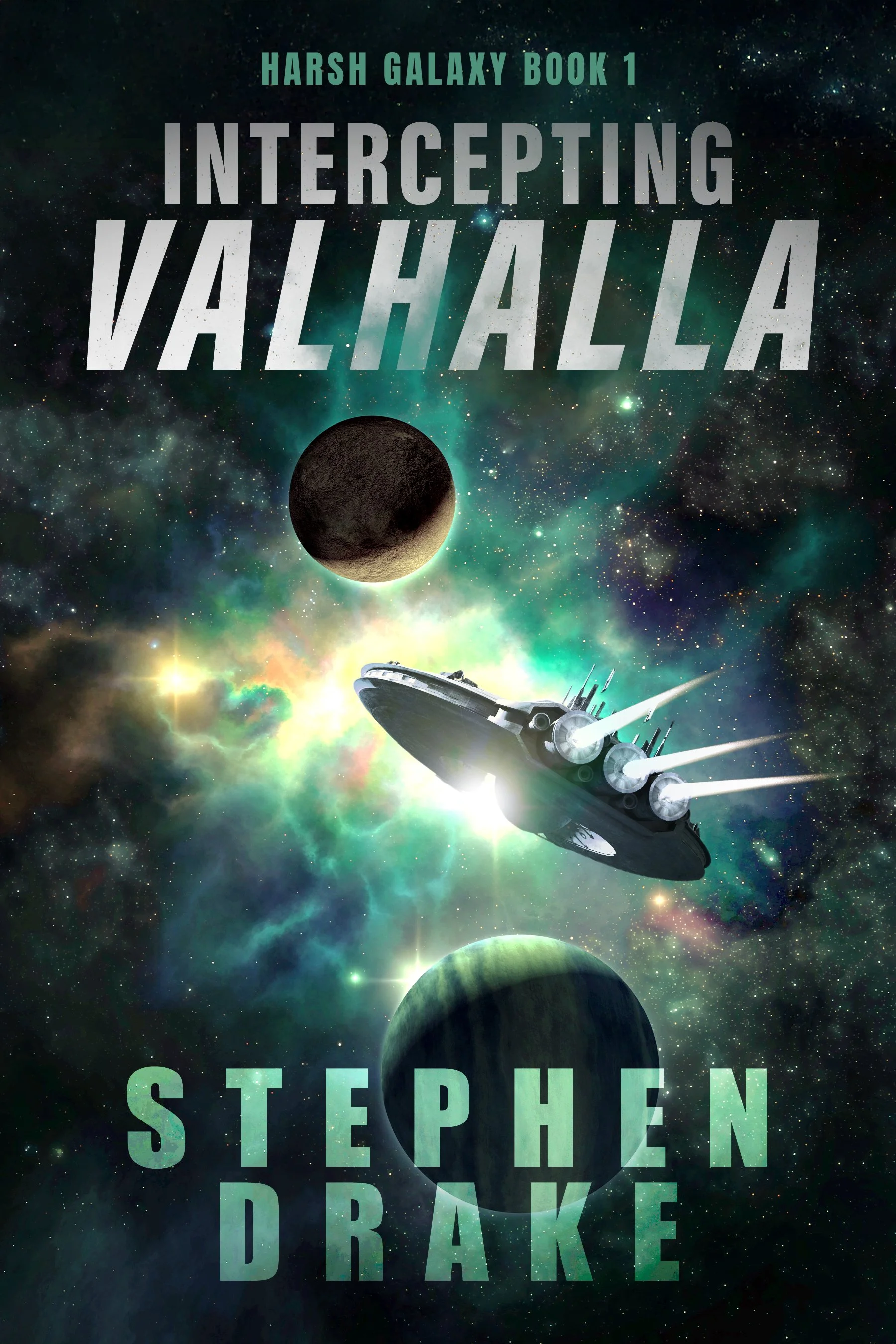
Intercepting Valhalla (Harsh Galaxy Book 1)
One Earthling. No Home. No Way Back.
In a galaxy where Earth has been cut off for centuries, Henry Dazenhaus—a boy abducted from Earth in the late 1990s—has spent a lifetime surviving alien worlds that never wanted him. Sold into slavery, experimented on, and ultimately trained by a member of the Galactic Assassins Guild, Henry has become something far beyond human... and yet not entirely alien.
Now an adult, he drifts from system to system, doing whatever it takes to stay alive in a universe that sees him as other. As he navigates the brutal politics and prejudices of galactic life, one question haunts him: is Earth still his home, or just a memory better left behind?
Start reading today and explore a sci-fi saga of survival, identity, and the search for belonging in a universe that forgot Earth.
Excerpt from the book
The proximity alert to the hyperspace beacon indicated it was time. I had been sitting in the command chair with my legs draped over the armrest, my feet on the co-pilot station. I straightened up, like a normal person, as my mother had told me for years, sitting in my command chair.
“Return to normal spaceNormal space.”
“Acknowledged,” the ship’s AI responded and triggered the Jumpgate sequence.
The swirl of dark blue, purple, and black that was hyperspace began to clear on the holographic representation in front of me. I saw the familiar jump-gate vortex in the center, indicating the gate opening with an open star field in the middle. The ship shot out of the Jumpgate with enough velocity to clear the Gate in case someone was coming in right behind me. It was all according to established protocol.
“Welcome to the Proxima Centauri Star system,” the recorded message said. “You are to report to the space station out-system from Proxima B. Please have your papers ready.”
No one knew who built the Hyperspacehyperspace Jump-Ggate Network. It took years to figure out what they were, when first discovered, and how to open them. Since then, several races have explored and mapped the network. Those races freely shared their information concerning the Gates.
The Gates Jumpgates opened a manufactured quantum singularity, allowing trade and travel between star systems. They also allowed for the movement of some military ships.
FTL—Faster Than Light— travel was a fantasy. The Jumpgates allowed entrance into hyperspace. HyperspaceHyperspace was like a vast, raging river running outside the boundaries of nNormal space. It magnified a ship’s velocity so that travel to other star systems would take weeks or months instead of years or, in some cases, generations.
All Jumpgates were located at the furthest LaGrange point in any system to reduce the effects of the stars’ and planets’ gravity on the Gate. They had to be as stationary as possible.
Any ship entering hyperspace had to have functioning defensive shields tuned to a specific minimum frequency and at minimum strength. Otherwise, the forces inside hyperspace would tear the ship apart.
Tachyon relays are used as marker buoys for each Gate.
Because of the complexity of hHyperspace travel, a ship’s Artificial Intelligence—AI— had complete control of the vessel while in hyperspace. If not, a ship could be hopelessly lost, as there were no navigational reference points. No stars were visible inside hyperspace.
Most races couldn’t look directly at the miasmic swirling of hyperspace for long periods. Some pilots would send a small charge through their canopies and ports to increase opacity, or the AI could display it on a screen or holographically render what was visible from the pilot’s position, or the sensors’ information, in front of the ship.
Another indicator flashed to inform me that incoming and outgoing messages were exchanged; this was also protocol. Interstellar communications were, at best, terrible. All ships entering or exiting systems uploaded messages destined for systems along their flight paths. Only the ship’s AI knew what messages were there. Once messages were successfully uploaded, they were purged from the ship’s system.



Sed purus sem, scelerisque ac rhoncus eget, porttitor nec odio. Lorem ipsum dolor sit amet.