



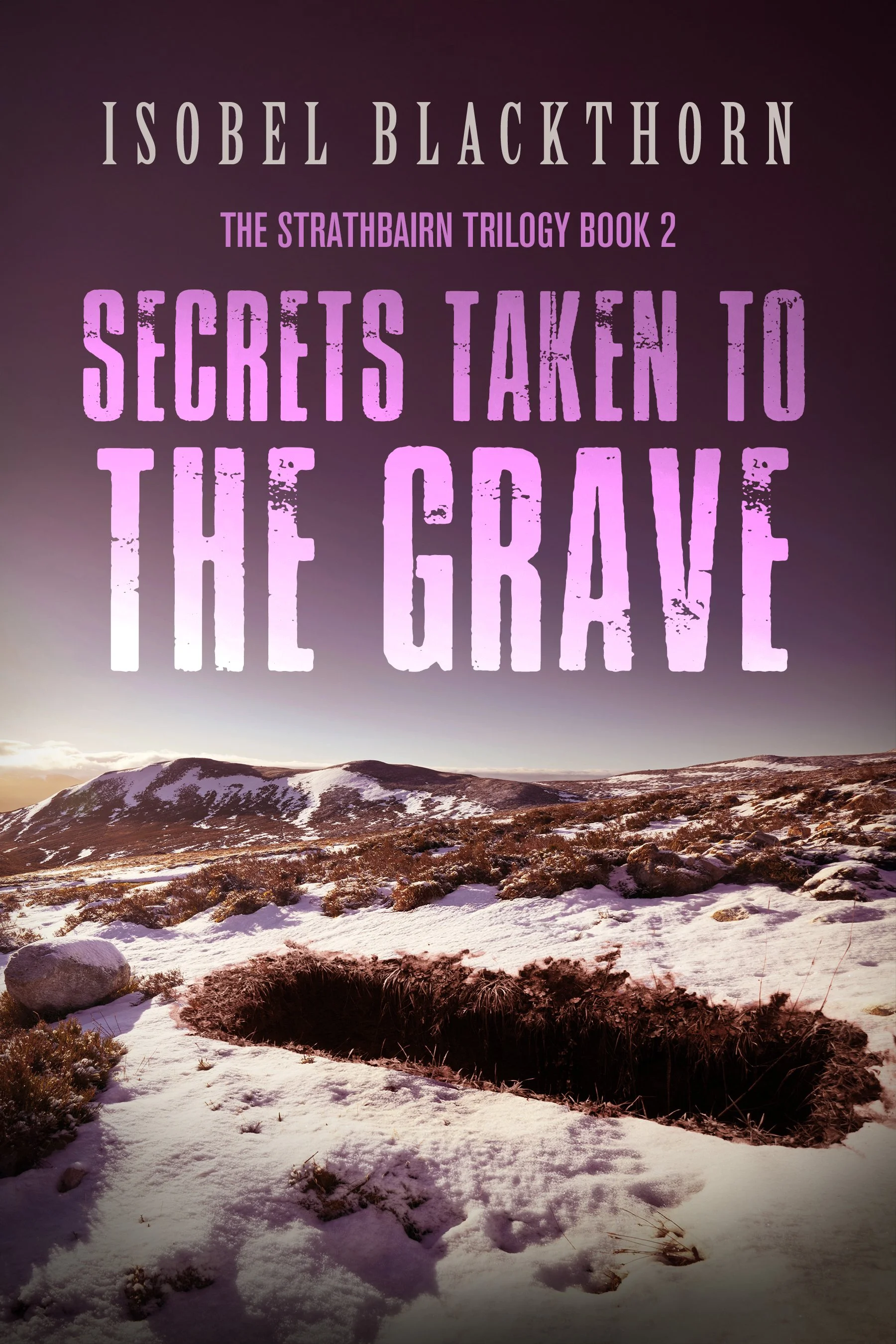
Secrets Taken to the Grave (The Strathbairn Trilogy Book 2)
Secrets Taken to the Grave
The Scottish Highlands, 1893. Ingrid Barker returns to Strathbairn for the funeral of her former employer, Charles McCleod, but the moment she steps onto the estate, unease claws at her. When whispers of murder shadow the graveside, Ingrid can't ignore the feeling that something is terribly wrong. Her worst fears come alive when Charles' vengeful ghost begins to haunt her, forcing her to confront secrets she desperately wishes to forget.
As Ingrid races to uncover the truth and flee Strathbairn, another murder strikes far closer to home, binding her to the place she most wants to escape. Trapped between dark family secrets and a growing danger, Ingrid must face the past — and the ghost of Charles McCleod — before time runs out.
A chilling gothic mystery filled with atmosphere, Secrets Taken to the Grave is the gripping second book in Isobel Blackthorn’s Strathbairn Trilogy.
Lose yourself in a story where every shadow hides a secret — get your copy of Secrets Taken to the Grave today.
Excerpt from the book
I can scarcely believe I am back. After all that happened at Strathbairn, this gloomy valley remains the last place on earth that I would wish to find myself. And yet duty beckons and here I stand, beholding the moss-covered bog, contemplating those icy depths that guard a terrible truth. With my daughter’s hand firmly in mine, I brace myself. Memories bombard me, an army assaulting my mind with the horrors that occurred here.
To my right, pony carts and carriages litter the drive. Then there’s the house, bearing down on its surrounds as it always did—grey, with the gables and crenelations of the roof, and the small, diamond-pane windows framed in black. It is a house that oozes its own dark history from every pore of its stonework.
With a single sweep of my eye, I take in the mountains that impose themselves on this narrow valley, their treeless and windswept slopes, their crags. They haven’t changed one iota, and why would they. The only difference the sprinkling of early winter snow capping the crests.
The air is still and cold, the thin wintry light of noon failing to penetrate much of this valley thanks to those mountains. Up high, beyond the crest to the north, sits the old abbey. Thankfully, from here those ruins are not visible, for I cannot bear to think of what they contain.
At this point, if there had been some means of escape, I would have taken it. But the carriage that brought me here from the station has already left, I can hardly steal one of those parked on the drive, and walking is unthinkable. It’s much too far. There is nothing to be done other than join those gathered on a knoll on the other side of the house, where the land slopes up to meet the burn. A stand of ancient pine trees shelters the knoll. Beyond, the valley narrows, coming to an end at the base of the mountain to the west.
Susan and I are late. The McCleod family, garbed entirely in black, have their heads bowed. Others—many also in black, others in dark brown attire—stare blankly ahead.
I’m relieved to have opted for a dark-grey worsted skirt and matching winter jacket, the black fur of the collar and the black lace embroidery on bodice and cuffs adding an elegant touch. The addition of black ribbon on my hat completes the look. Sufficiently funereal, and yet wearable on many other serious occasions. I managed to persuade Susan to put on her dark-blue dress and forego the bright-coloured ribbons she is so fond of. In all, we are appropriately dressed, if something of a contrast.
As we draw near, taking the last few steps up towards the knoll, I catch snatches of commentary from the local clergyman. It’s the usual funeral sermon by the sound of it—he’s reciting a Psalm—and I can only imagine what is passing through the hearts and minds of those mourners, for it surely cannot resemble grief. I cannot imagine anyone grieving the loss of Charles McCleod, least of all his own family.
Noticing us, Miles—standing with his hands clasped behind his back on the other side of the open grave—catches my gaze and gives me a slight, expressionless nod before bowing his head beneath his bowler hat. He appears tense, strained. I can see that it has taken a lot for him to be here.

Sed purus sem, scelerisque ac rhoncus eget, porttitor nec odio. Lorem ipsum dolor sit amet.