



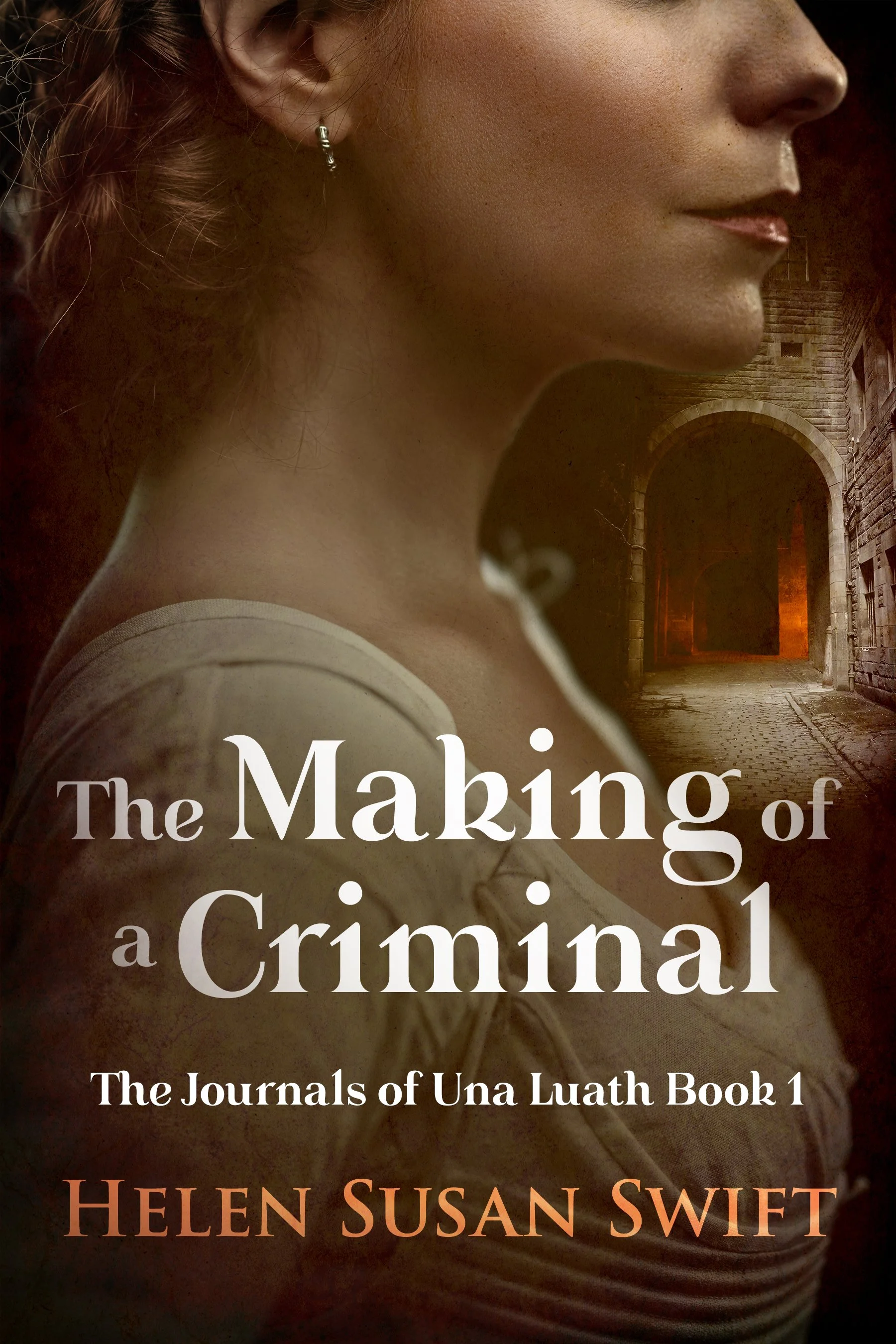
The Making of a Criminal (The Journals of Una Luath Book 1)
The Making of a Criminal
In 1788, as the shadow of the gallows stretches across Edinburgh, a young servant named Una Luath witnesses the execution of the notorious Deacon Brodie—unaware that her own descent into the city’s underworld is only just beginning.
Betrayed by Lord Henry Cuthill and abandoned by those meant to protect her, Una is cast from the grand house at Calton Neuk into the unforgiving closes and wynds of the Old Town. Rescued by unlikely guardians, she finds refuge beside the Nor’ Loch among thieves, housebreakers, and society’s forgotten. Under their guidance, she learns to survive—picking locks, reading dangers, and navigating the hidden codes of a city divided by wealth and power.
But Edinburgh’s underworld answers to its own authority. Judge Neville Buchanan—known as the Colonel—rules through fear, backed by a circle of loyal bruisers who dispense brutal justice. When Una’s new family falls victim to the Colonel’s reach, survival is no longer enough. Armed with hard-won skills and sharper resolve, Una begins to plot her revenge against those who have wronged her.
Told in the first person as the opening volume of a three-part journal, The Making of a Criminal is a 75,000-word work of historical fiction set between 1788 and 1793. Rich in period detail and rooted in the real streets and scandals of eighteenth-century Scotland, the novel explores power, betrayal, and the cost of justice in a city poised between Enlightenment refinement and criminal enterprise.
Begin the Journals of Una Luath and step into the dark heart of eighteenth-century Edinburgh.
Excerpt from the book
EDINBURGH, SCOTLAND
OCTOBER 1788
I remember the hanging as if it were yesterday, rather than forty-five, or was it fifty, years ago. William Brodie, the Deacon of the Incorporation of Wrights, and an Englishman named George Smith were hanged for burglary and murder. Brodie had tried to flee, but George Williamson, a King’s Messenger, tracked him down in the Netherlands and brought him back to Edinburgh to face justice.
I did not know the details of the deacon’s crimes, only that they were heinous and set Edinburgh ablaze with speculation and rumour. The senior servants spoke of Brodie in hushed tones and tried to keep my innocent young ears from hearing too much. However, there was no attempt to keep me away from the actual hanging. Presumably, the occasion was intended as a warning to keep me on the straight and narrow path to salvation. My memoirs will show how effective that idea proved to be.
Nonetheless, some of the details of the deacon’s death imprinted themselves on my memory.
I remember the two condemned men standing on the timber platform adjoining the Tolbooth, with the ugly gallows behind them. There were rumours that Brodie designed the gallows on which he was to be hanged, and that may or may not be true. I do not know.
I also remember the soldiers in scarlet and white splendour keeping back the watching mob. The soldiers appeared nervous rather than brutal, with their hair carefully powdered and drawn back from their foreheads, and their long Brown Bess muskets heavy in the autumn sunshine. Some looked very young, others aged and weary, perhaps veterans of the late war with France, Spain and the American Colonies.
I heard the baying of the crowd as the two condemned men faced them. Some say there were forty thousand people gathered there to witness the good deacon and his companion dangle at the end of a hempen rope. Others say there were more. I do not know the truth. I only know that Edinburgh was packed with spectators, mostly the native burghers, or good neighbours as they liked to be termed. Others had travelled from all the airts for the free entertainment the judge had provided. I watched, open-mouthed, for I had never seen a hanging before. Such events were not as common in old Edinburgh as in other cities.
My Lord Cuthill was there, of course, foregathering with the unco good as well as the somewhat unsavoury to shake his head sorrowfully at the sins of Man, then turn aside to open his snuff box. He shook a healthy amount onto the back of his hand, sniffed and sneezed heartily. He successfully hid his smile, but I knew he secretly enjoyed every second of the day’s events. That was my Lord Cuthill; may he birl on Satan’s spit for eternity.
Lady Lucy Cuthill was also present, but she did not concern herself with hiding her pleasure. Her eyes were shining with delight as the hangman placed the nooses over the condemned men’s necks. She smoothed her immaculate purple cloak, adjusted her favourite hat, turned aside for a second to speak to her friend and admirer, Mrs Paterson, and immediately returned her attention to the gallows.

Sed purus sem, scelerisque ac rhoncus eget, porttitor nec odio. Lorem ipsum dolor sit amet.