



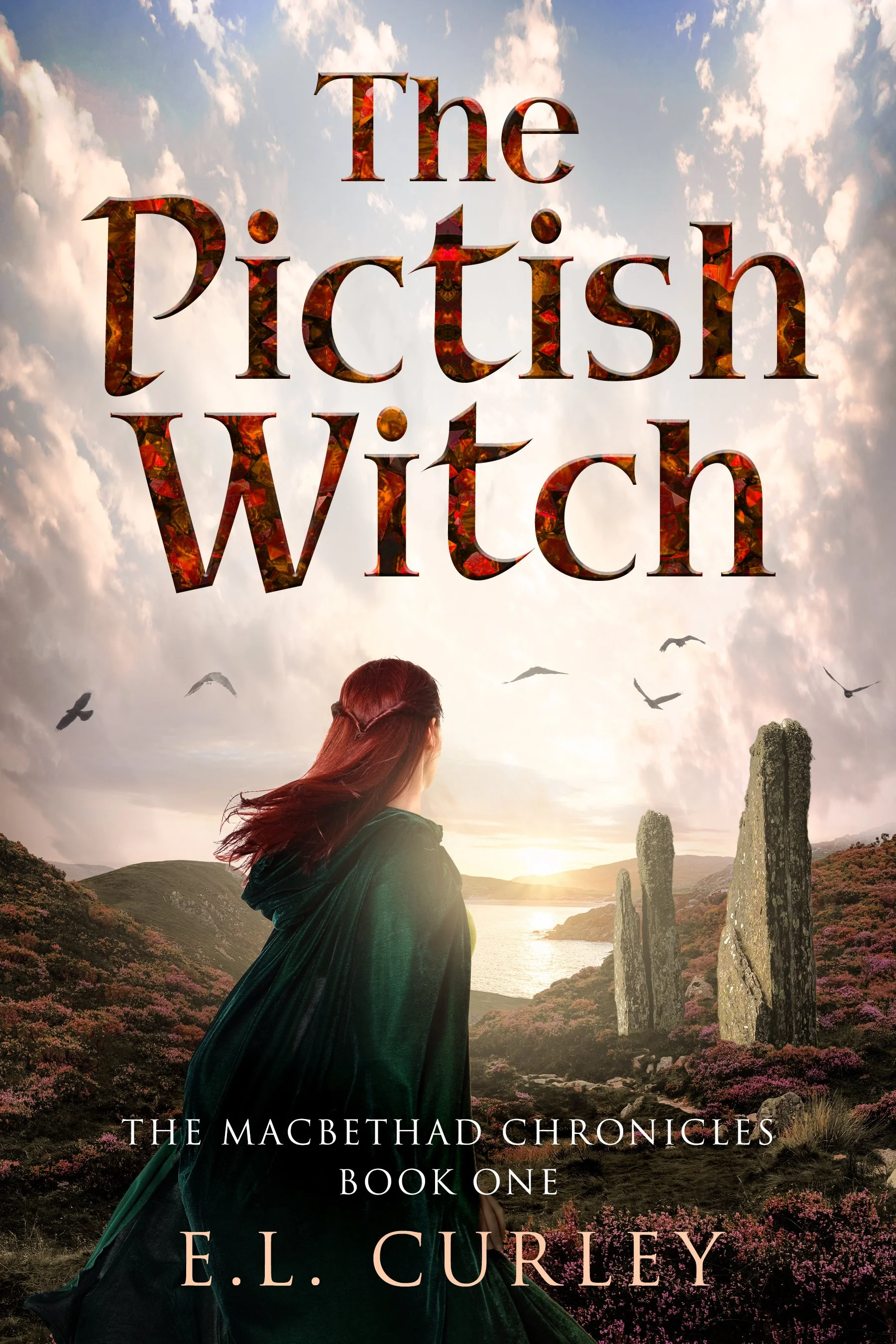
The Pictish Witch (The Macbethad Chronicles Book 1)
Witchcraft, prophecy and power collide in 11th-century Scotland
As an ageing king nears death in 1034 A.D., unrest spreads across the ancient Kingdom of Alba. Eithne, a young woman learning the ways of witchcraft, is drawn into a deadly prophecy that threatens both her life and those she loves. With her brother, a mysterious woman in white and a faithful wolf at her side, she journeys across the wild Highlands in search of the protection of Macbethad of Moray. Within his court of warriors, Eithne discovers friendship, love and new enemies—but as the prophecy closes in, she must decide how far she is willing to go to change her fate. Inspired by the life of the real Macbeth, The Pictish Witch by E.L. Curley blends Scottish historical fiction, Celtic fantasy, romance and magic in the first book of the Macbethad Chronicles.
Begin Eithne’s journey in The Pictish Witch.
Excerpt from the book
I come from a long line of Picts. We have toiled this land for hundreds of years, carving our lives into soil and stone. We have always lived by the roll of the sun across the sky, the phases of the moon, and the changing seasons. But, as with all things across time, the old ways change, fading away until they crumble to dust and disappear from memory. The deities of nature recede, slipping unnoticed through the cracks, fading shadows in the half-light, taking with them the echoing footsteps of our ancestors.
The new faith has risen, with worship conducted inside stone and wooden temples, not under an ancient oak, within a circle of stones, or at the foot of a carved monolith. We are to worship one man, who will save us from sin. The old ways may be fading, but deep within me I can still feel them, my ancestors of the painted race, and they must not be ignored.
My grandfather always told me I would grow up to know the same craft as my mother. She had harnessed a great power, like her mother before her, a power that goes back to the Cailleach. I feel it grow in me: the tingling in my fingertips, the heat in my eyes, and the fleeting images that visit when they will.
I often walk to a circle of stones close to my home. It is my church of learning. It is where I hear the low hum of the stones as they connect to the earth, a sombre song of time before time. There is an ancient power that will speak to you if you have the mind to listen. I can hear them: whispers from another realm, speaking in a different tongue, but there is always one voice I listen for. I long to hear her voice, but it does not come.
My mother died, and my father shortly after, when I was only three summers old. They are both buried in a copse at the back of our farmstead, where the bee skeps are, lying within a grassy mound alongside the rest of our clan. My brother, Drest, and I have been raised by our grandfather ever since, just the three of us working our small patch of land.
Our dwelling place is as you’d expect to find: long, low and built of wattle and wood, with an overhanging broom thatch that has seen better days. Through one door is an open hearth in the centre of the floor, with my sleeping pallet at one end and the men down the other. Above the wax-speckled table by the hearth hangs an assortment of my herbs, their delicate scent not quite lost to the pungent woodsmoke drifting lazily towards the hole in the roof.
Our steading sits on its own with none other close by, surrounded mostly by woodland and, to the east, a swathe of moorland that meets the foothills of the Sidlaws. We are beside a long bridleway that leads to the bustling market town of Scone, and the monastery there sees men of the new religion learn and preach the word of God. I’ve heard that many men of that inclination travel from far and wide to attend Scone to learn their craft, but it is nothing like mine.

Sed purus sem, scelerisque ac rhoncus eget, porttitor nec odio. Lorem ipsum dolor sit amet.