



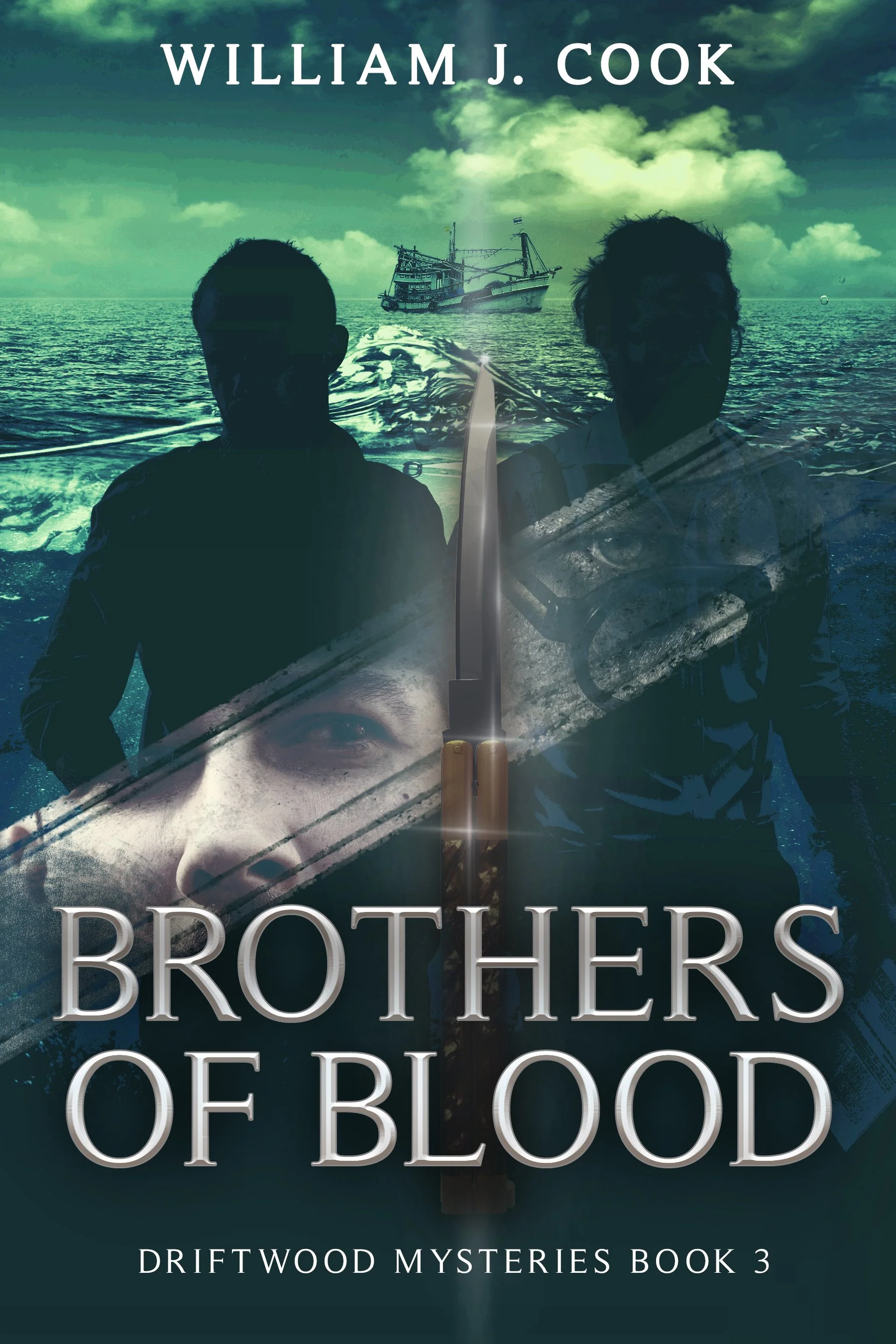
Brothers of Blood (Driftwood Mysteries Book 3)

Brothers of Blood
When a crab boat vanishes off the coast of Driftwood, Oregon, Officer Charley Whitehorse suspects the tragedy was no accident.
As young women disappear along the Oregon coast, Charley and former Navy SEAL Chris Harper uncover a trail of sabotage, trafficking, and murder that leads from a powerful fishing company to a Russian crime boss with ties to influential politicians. What begins as a local investigation soon pulls them into a dangerous conspiracy reaching far beyond Driftwood.
Racing to stop the killer and expose the truth, Charley must follow the clues offshore, where secrets, violence, and betrayal await aboard a luxury yacht.
Gritty, fast-paced, and layered with coastal atmosphere, Brothers of Blood is the third book in William J. Cook’s Driftwood Mysteries series.
Read Brothers of Blood today and return to Driftwood for a crime mystery where every clue cuts deeper.
Excerpt from the book
MONDAY, JANUARY 7, 2019. The first storm of January had begun in earnest. Although the sun had not appeared all week, today the roiling black clouds seemed to suck even the faint remaining light from the late afternoon sky, creating a premature twilight. In the darkness, the twelve-foot swells were liquid mountains, rushing headlong toward them, indifferent to the boat bobbing on the surface, unforgiving of any mistakes the three-man crew might make. Even with the howl of the wind and the slashing of the rain, the men could hear the whistler buoy astern, moaning like the soul of a drowned fisherman.
“Are we having fun yet?” Derek Lea shouted to his crew mate Rick Perrins over the roar of the wind. The rain smacked his bright yellow foul-weather gear with a ferocity that seemed bent on shoving him overboard. Waves thundered over the bow, drenching him with walls of water. His mouth filled with the briny taste of the sea. Even through his layered clothing, the cold was leeching the warmth from his body.
“This is nuts!” his partner yelled back. They could barely hear each other, but each knew what the other was thinking. Long familiarity with the hazards of the Pacific made them almost telepathic. Perrins shivered in the onslaught and spat onto the deck. “What are we doing out here?”
“Earning a living, numb nuts!” He drew his hood tighter over his head.
“There's gotta be an easier way!”
“Of course there is! But everything else is boring!” With the deft hands of years of practice, Lea gaffed the line from a crab pot resting on the sea bottom in fifty feet of water. He looped it over the block, a circular winch at the end of a stainless steel arm, bent at the elbow over the side of the boat, its hydraulic muscle ready to haul the heavy pot out of the water. The pots or traps were round disks about three feet in diameter and a foot high. Metal grates were wrapped around steel frames, making cylindrical cages. One-way doors on opposite sides of the traps allowed crabs to crawl in toward the bait, but not back out.
He engaged the block. The line tightened and came thrumming in. When the three white marker buoys shaped like artillery shells reached the winch, he flipped them away from the gear and back out into the water. As the pot broke the surface, he hit the lever on the gunwale, and the arm of the block extended upward and swung toward the boat, lifting the pot within easy grasp of the two men.





Sed purus sem, scelerisque ac rhoncus eget, porttitor nec odio. Lorem ipsum dolor sit amet.