



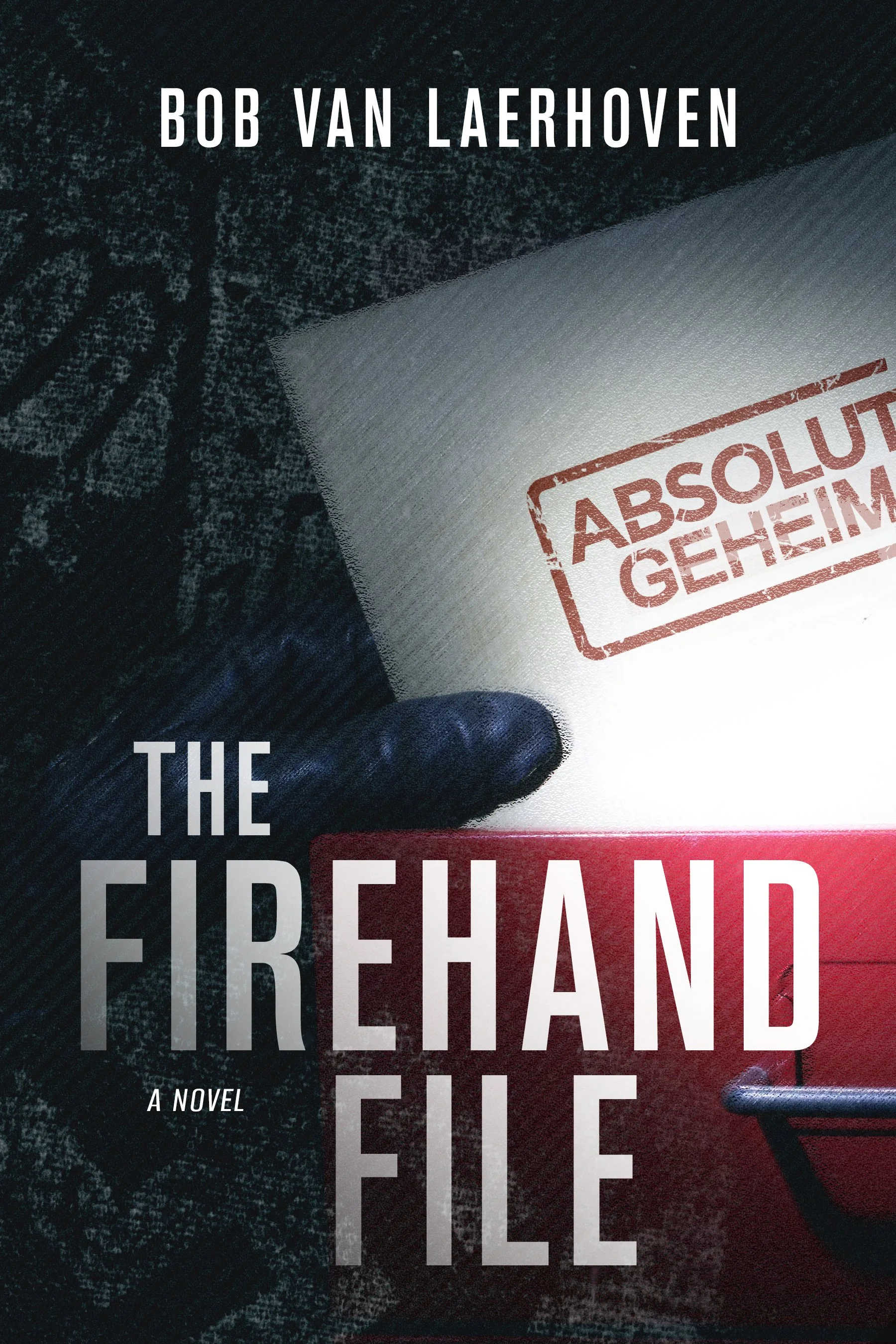
The Firehand File

A Dark Thriller in the Heart of Weimar Berlin
Berlin, 1921—where political unrest erupts by day and fear stalks the streets by night. A serial killer known only as “The Skinner” leaves a trail of terror, eluding even the sharp instincts of Inspector Chaim Orlosow, who suspects a war-scarred veteran behind the brutality.
Amid this volatile backdrop, the lives of Flemish DADA poet Paul Van Ostaijen and his impulsive partner Emma Clément begin to fracture. Struggling with poverty, addiction, and betrayal, they are drawn into something far more dangerous when Van Ostaijen steals a mysterious file from the apartment of enigmatic spy Elise Kraiser. What begins as a reckless act quickly spirals into a chain of events that intersects with rising political forces—and a name that will shape history: Adolf Hitler.
The Firehand File by Bob Van Laerhoven is a gripping historical thriller that blends crime, art, espionage, and the uneasy birth of a new political era, capturing the tension and decadence of post-war Berlin with striking intensity.
Discover the secrets hidden in the Feuerhands Obsession file and step into a city where every choice carries consequences.
Excerpt from the book
Never mind the thunder
and the lightning in the sky,
we Berliners snort and spray.
Cocaine, our fog of wonder,
we’ll snort until we die,
let the madhouse be our way.
Dear God, who on earth
Gives a damn anymore?
Europe’s crazy, anyway.
As for paradise, what mirth!
We’d sneak in through that door,
so let’s snort and let’s spray.
Herr Doktor Heinz Baumgart can’t get rid of the annoying cabaret song in his head. The crowd at Grunewald, the Berlin racecourse, seems to sway up and down, making him dizzy. The racecourse gamblers, unsavory fools with shiny tie-pins and grey top hats, try tirelessly to raise the bets.
It’s April 1921 and - thinking of April craziness - the sun is like an oven.
Herr Doktor Baumgart bathes in sweat and it’s barely spring, dammit. The Great War swallowed countless corpses and now the ground exudes fumes that make the climate unpredictable. Yesterday, rain poured like a water cannon; now, there’s a sun like a searchlight.
Baumgart’s hair, richly smothered in brilliantine, smells of cinnamon. His collar is strangling him. What possessed him to put on a suit from last year? Since then, he has grown in girth, learning, and patriotism. But also in agitation. He is a psychiatrist. This morning, he analyzed an interesting patient’s long and exciting diary entry.
Afterward, he snorted and sprayed and went searching for fresh air.
A peacock feather on a tiny hat attracts his attention – a silhouette with the graceful posture of a tightrope walker. The hips of a budding Egyptian slave girl with slanting eyes and black irises seem to burn a hole in Baumgart’s hat. Despite the heat, her velvet gloves cover her elbows. A daring silk dress, yellow, frivolously wavy, twisting suggestively, cut just below the knee.
All that without a drop of sweat.
Herr Doktor Baumgart immediately forgets his nationalistic concerns and profound aversion to the Jewish gambling stalls in Grunewald, which deceive their punters indiscriminately.
He decides to address the nymph to make her part of his rich spiritual life.
Ayin tachat Ayin. An eye for an eye.
Inspector Chaim Orlosow has read a lot about justice in his life, in both religious and secular books. So, what did it teach him?
That the principle of an eye for an eye eventually leaves everyone blind.
He waits for the young Armenian, Soghomon Tehlirian, to appear in the interrogation room. A verse from the Talmud, Yoma 22, bubbles up in his memory.
The one who grants mercy to the perpetrators of cruelty will eventually show cruelty to the givers of mercy.
Orlosow sighs. So many contradictions in life. Especially in religion. No wonder piety incites violence.
Inspector Orlosow focuses his mind on the final interrogation of Soghomon Tehlirian. During the last session, he ordered the court officer to record how the Armenian murderer had been arrested.
It hadn’t required strenuous police work. “Witnesses have confirmed that Soghomon Tehlirian shot the Turk Talaat Pasha in broad daylight in the street on March 15. I was one of these witnesses. When I arrested him, Mr. Tehlirian did not resist. On the contrary, he confessed to the murder immediately.”
The record was pointless, a stock scene in the vaudeville of the law. The inspector had added a final comment: “After several interrogations, the accused comes across to me as a sensitive, traumatized man. I have not detected in him the moral and intellectual blunting characteristic of the typical murderer.”



Sed purus sem, scelerisque ac rhoncus eget, porttitor nec odio. Lorem ipsum dolor sit amet.