



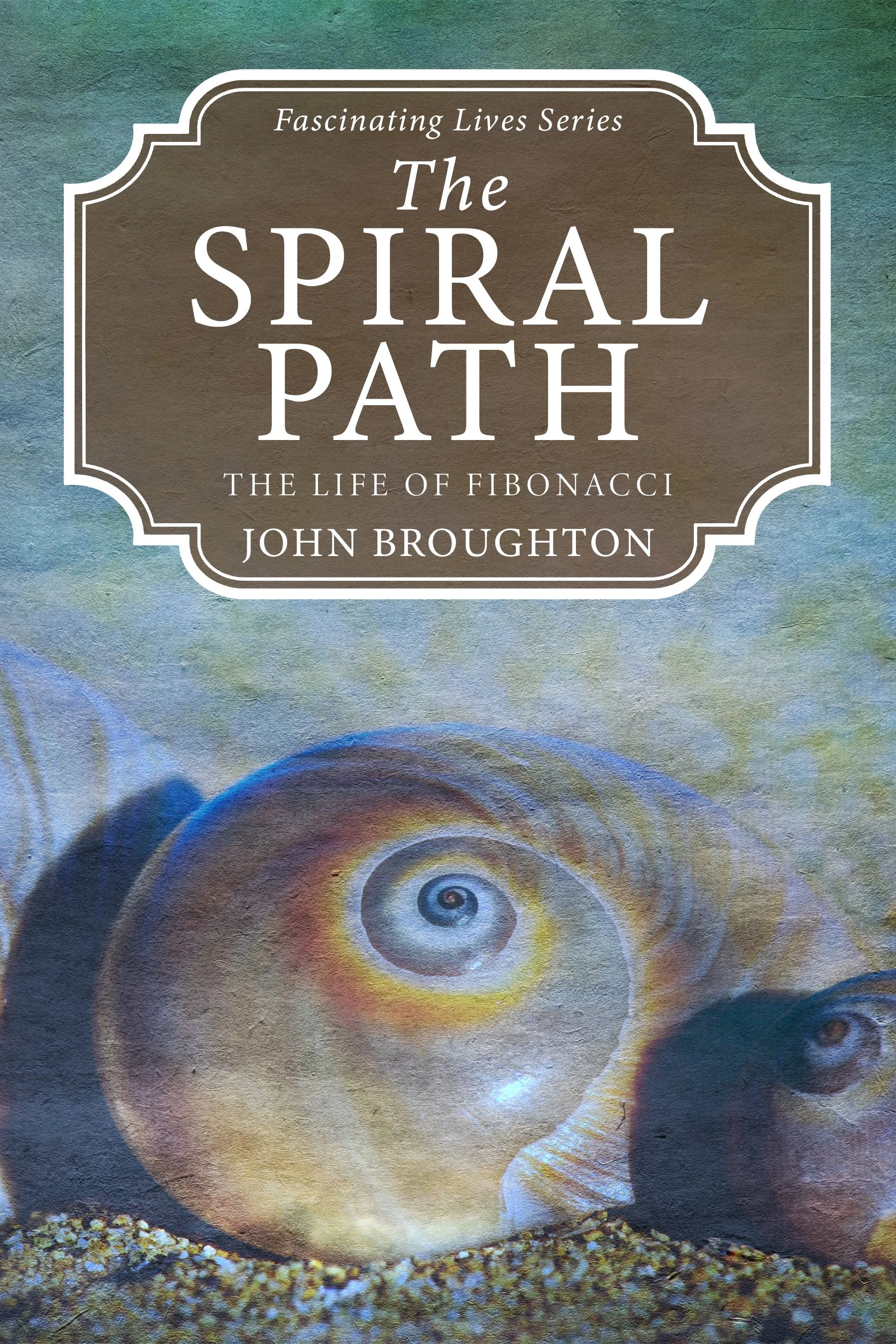
The Spiral Path (Fascinating Lives Series)
The Story Behind the Sequence: Leonardo Fibonacci’s Journey of Genius and Resistance
In The Spiral Path, John Broughton brings to life the extraordinary and little-known journey of Leonardo Fibonacci—mathematical pioneer, sword-wielding scholar, and reluctant hero of history. Set in the vivid landscapes of 12th-century Pisa, Palermo, and North Africa, this richly detailed historical novel follows young Leonardo from merchant’s son to the mind behind the numerical revolution that reshaped Europe.
From surviving pirate attacks to studying with Moorish philosophers, Leonardo’s path is marked by danger, discovery, and the relentless pursuit of knowledge. His publication of Liber Abaci introduces Europe to the power of Arabic numerals, setting off a wave of change—but also triggering suspicion from religious authorities and rival merchants. As his wife Cecilia’s success in perfumery draws charges of witchcraft, and his mathematical inquiries attract the Inquisition’s attention, Leonardo must navigate treacherous political and religious tides to preserve his life’s work.
At its heart, The Spiral Path is a tribute to intellectual courage, the power of numbers, and the timeless beauty of the golden ratio that shapes both nature and art.
Step into a world where one man’s vision challenges centuries of tradition—and changes everything.
Discover the legacy of Fibonacci in The Spiral Path — now available in print and digital formats.
Excerpt from the book
Maritime Republic of Pisa, 1177 AD.
Guglielmo Bonacci strode along the wharf at Pisa harbour, his steps exuding a quiet confidence that stopped just short of arrogance. Despite the considerable wealth that lined his coffers, he carried himself with a modest demeanour. The society he was part of demanded a display of status, and his attire was a testament to that expectation. He wore a fine blue linen tunic, the fabric smooth and luxurious to the touch, adorned with delicate, intricate embroidery that hinted at his affluence without boasting. Draped over his shoulders was a long, flowing mantle, the inner lining a testament to his prestige, made from the softest squirrel fur that glinted subtly in the sunlight. Both garments were meticulously tailored to fit his form, secured by a sturdy leather belt with a decorative buckle that cinched the tunic and cloak together seamlessly. His polished leather boots moved with precision, carefully stepping around the seawater puddles that dotted the quay. It was imperative to keep his cream-coloured, close-fitting hose pristine, unsullied by the dirty water that threatened to splash and soil them.
Guglielmo watched intently, his sharp eyes tracing the movements of his son, Leonardo, who perched on a weathered wooden bollard by the bustling harbour. The boy’s gaze never wavered as he observed the majestic vessels navigating in and out of the port with practised ease. Guglielmo had no doubt whatsoever about his son’s exceptional nature. Over lunch, as they sat at a rustic table with the aroma of fresh bread and olives in the air, the boy would chatter with remarkable insight about the morning’s maritime activities. His mind, sharp as a freshly honed blade, calculated and dissected each detail with precision. His powers of observation were nothing short of extraordinary.
In the twelfth century, the Pisan trading vessels were marvels of construction, known for their dual capability to glide through the winding Arno River and brave the vast expanse of the Mediterranean Sea.
These vessels, combining the agility of river boats with the strength of ocean-going cargo ships, emphasised Pisa’s crucial position in connecting the Tuscan inland to faraway ports.
Young Leonardo was a valuable asset to his father, thanks to his remarkable memory. He could recount with uncanny accuracy the number of ships that had ventured into the Tyrrhenian Sea that morning, detailing the barrels of wine, sacks of grain, and bundles of cloth they carried. With an almost theatrical flair, he would then list the flat-bottomed riverboats, their decks laden with crates of olive oil and baskets of fruit, as if each detail were a treasure to be shared.
Thus, it was no surprise that Guglielmo, with his almost mystical command of the local mercantile affairs, managed to captivate the attention and admiration of fellow merchants who frequented the bustling port of Pisa. His reputation as a man of intellect and perception grew steadily, each retelling of his insights serving to bolster his standing within the community. Merchants marvelled at his ability to recount not just the arrivals and departures of ships but the contents they carried—from barrels brimming with wine to sacks stuffed with grain and bolts of fine cloth. This prowess for detail did not go unnoticed by those in power.


Sed purus sem, scelerisque ac rhoncus eget, porttitor nec odio. Lorem ipsum dolor sit amet.