



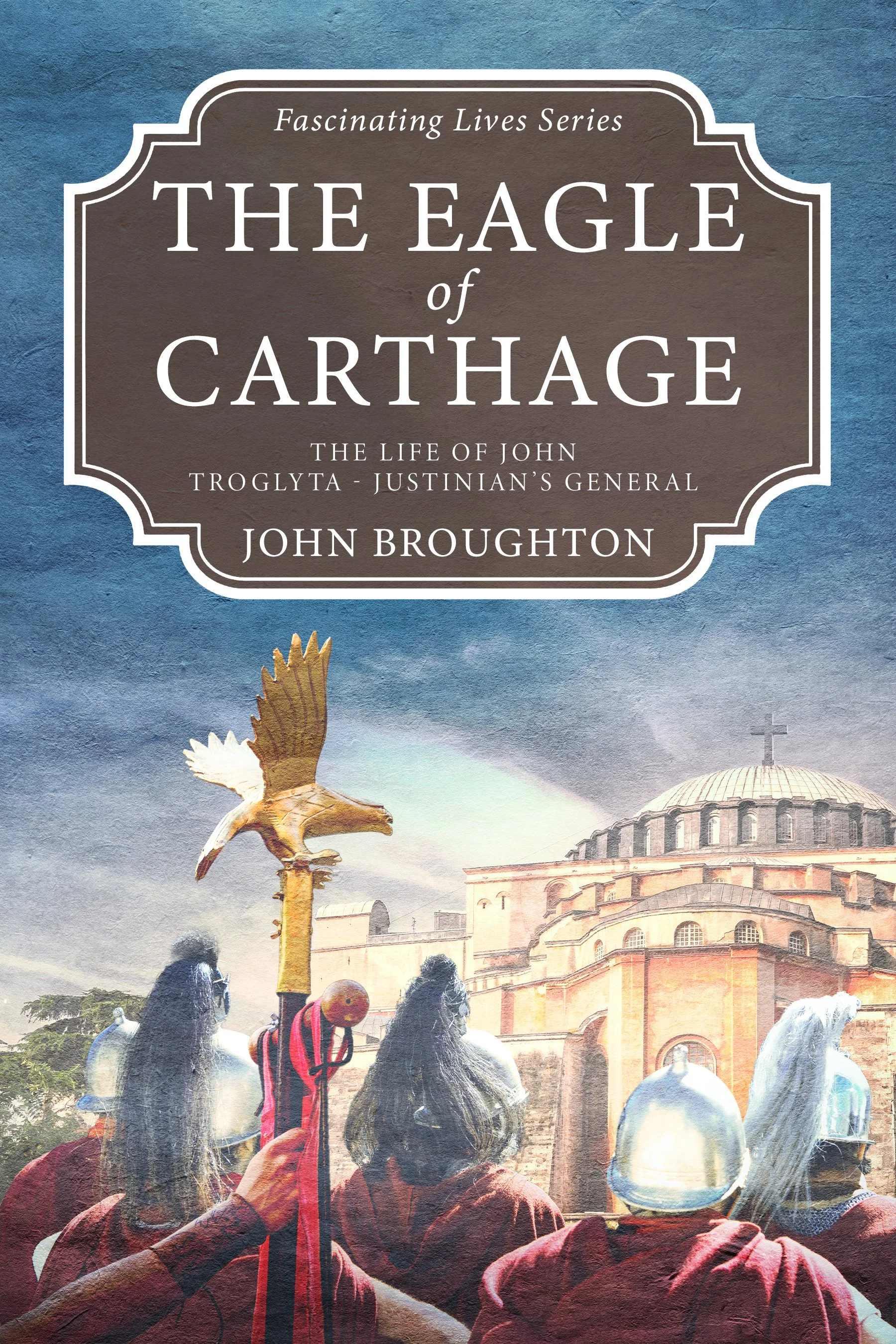
The Eagle of Carthage (Fascinating Lives Series)
The Eagle of Carthage
In 546 AD, the Byzantine province of Africa is close to collapse. Rebellion, political rivalry and years of war have weakened imperial control, leaving Emperor Justinian to entrust the province to General John Troglyta. Arriving in Carthage with a weary army and a small circle of trusted officers, Troglyta must navigate shifting Berber alliances, corruption within the imperial administration and the growing threat of the warlord Carcasan. From Constantinople to the battlefields and deserts of North Africa, The Eagle of Carthage is an epic historical novel of military strategy, political intrigue and the difficult choices required to hold an empire together.
Discover John Broughton’s story of one of Byzantium’s most important and overlooked generals.
Excerpt from the book
The sun had not yet cleared the jagged hills when John Troglyta dismounted beside the river, his chainmail creaking in the pale light. He ground his heel into the riverbank’s frozen mud, breathing the still air deep into his lungs until he tasted the sharp wetness of snowmelt and old leaves. All along the far bank, a ragged frost shimmered on the rushes, and an opalescent mist drifted above the water in furling bands, the kind that children in the old villages once believed were the restless spirits of men who had died without a proper burial. Somewhere beyond those shifting veils, past the black lattice of dormant trees and the tussocks of swamp grass, lay the territory of men who answered to no emperor, men who made their own laws out of hunger, memory and the long shadow of defeat.
Troglyta knelt and cupped both hands in the river, the water biting his knuckles. He splashed his face until his skin felt raw, as if the cold could scour away the dregs of sleep and the acrid taste of last night’s wine. He blinked hard, focused on the ripples and their endless march towards the sea, and let his mind go blank for a moment—just the chill, the crush of his own heartbeat and the sense of being absolutely present in the world.
A horse stamped behind him, shaking its bridle until the bit clinked. Boots crunched over gravel in a staccato rhythm, measured and unhurried.
“You’re up before the trumpets again,” said a voice just behind his left shoulder.
He did not have to look up to know it was Tribune Theodorus. Even at dawn, Theodorus moved like a man who saw every hour of the day for what it was—a small, necessary war against disorder. This morning, Theodorus bore two clay cups, their glaze etched with the faded purple sigil of the legion, filled to the brim with watered wine.
Troglyta straightened, water sheeting from his hair, and turned to accept the cup. “You make it sound like a crime.”
Theodorus gave a half-shrug, the kind that settled arguments before they started. “It’s a crime if the men see it. They might expect the rest of us to work as hard.”
Troglyta grinned and took a mouthful of wine. It made his gums ache, but the taste was better than most. “Then we’ll keep it between ourselves.”
They drank side by side, with the silence of men who had known each other for so long that words were rarely necessary. Theodorus was bareheaded this morning, his hair already thinning in anticipation of middle age, and his jaw was marked by the white nick of a recent shaving accident. He stood with one boot on a sunken stone, as if anchoring himself to the ground. Troglyta admired the posture—how it looked both casual and deliberate, as if Theodorus had planned to become a silhouette against this particular sunrise.

Sed purus sem, scelerisque ac rhoncus eget, porttitor nec odio. Lorem ipsum dolor sit amet.