



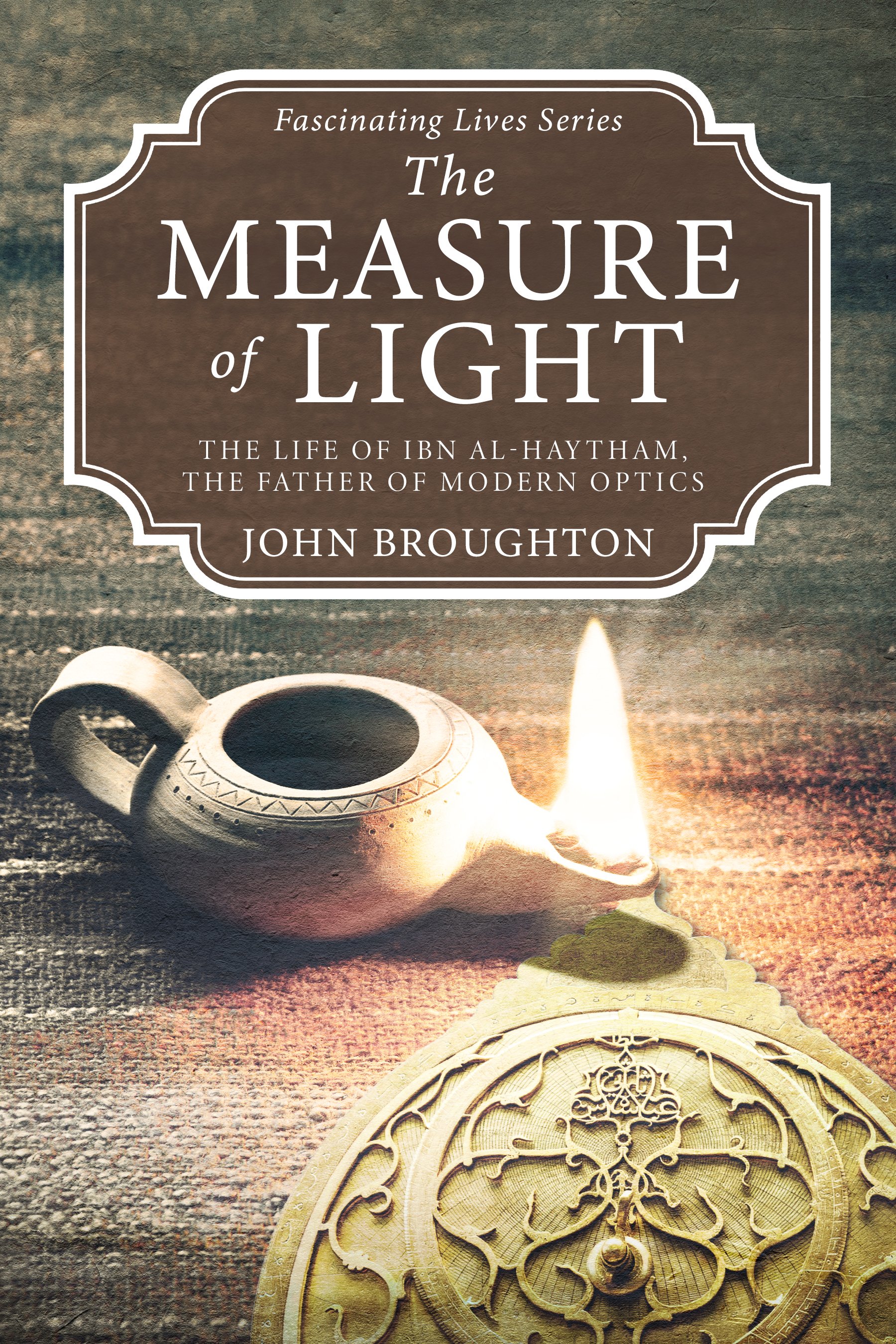
The Measure of Light (Fascinating Lives Series)
A story of ambition, doubt, and the discovery that changed how we see
In tenth-century Basra, Ibn al-Haytham believes reason can explain the world. But when the unpredictable Caliph Al-Hakim summons him to Cairo to control the flooding of the Nile, theory gives way to a dangerous reality: the task is impossible.
Facing the potentially fatal consequences of failure, Ibn al-Haytham chooses disgrace over death and retreats into confinement. With only the loyal and quick-witted Lady Zaynab beside him, he is forced to confront the limits of his knowledge—and the certainty that once defined him.
Then a beam of light enters a darkened room.
That simple observation leads Ibn al-Haytham to question centuries of accepted wisdom about light, vision, and perception. Through experiment, doubt, and painstaking observation, he begins to develop a new way of understanding the world—one that will ultimately transform the study of optics and influence generations of thinkers.
John Broughton’s A Measure of Light is a sweeping historical novel inspired by the extraordinary life of Ibn al-Haytham, exploring ambition, love, intellectual courage, and the profound idea that discovering the truth sometimes begins with admitting you were wrong.
Discover A Measure of Light and step into the life of the scholar who learned to see the world differently.
Excerpt from the book
The light in Basra was never still. It shifted across the courtyard in long, deliberate movements, breaking against walls, catching on the rims of clay jars, slipping through the narrow openings between roof and beam. Ibn al-Haytham watched it as it moved, his back against the cool plaster, a tablet resting idle in his hands.
“Are you listening?”
He did not answer at once. Across the courtyard, his teacher paused mid-sentence, a reed pen held above the page as though a thought had been interrupted. The other students glanced between them, some amused, others wary.
“Well?” the teacher said. “If the matter is beneath your attention, you may enlighten us all with something better.”
A few quiet laughs followed. Ibn al-Haytham lifted his head.
“You said,” he began carefully, “that vision proceeds from the eye—that it travels outward to meet the object.”
“That is what I said,” the teacher replied. “And what has been said by those far greater than either of us. Do you find fault with it?”
Ibn al-Haytham hesitated, not from uncertainty, but from the effort of shaping what pressed insistently at the edges of his thought.
“I do not understand how it can be so,” he said at last. “If the eye sends out something—rays, as you say—then why does it not see in darkness? Why does it not perceive what lies beyond a wall?”
The courtyard grew quieter.
The teacher set down his pen. “Because the eye requires a medium,” he said. “Air, light—these assist the rays in their passage.”
“But then,” Ibn al-Haytham said, leaning forward slightly, “is it the eye that sees—or the light?”
A murmur passed among the students. The teacher’s expression did not change, but something in it hardened. “You are not the first to pose such questions.”
“I do not wish to be the first,” Ibn al-Haytham said. “Only to understand.”
“And understanding,” the teacher replied, “begins with accepting what has already been proven.”
“Has it been proven?” Ibn al-Haytham asked quietly.
This time, there was no laughter. The teacher rose, brushing dust from his robe as he crossed the courtyard. He stopped a short distance from where Ibn al-Haytham sat, casting a shadow that broke the line of light on the ground between them.
“There is a difference,” he said, “between inquiry and contradiction. One leads to knowledge. The other—to confusion.”
Ibn al-Haytham lowered his gaze, though his grip tightened slightly on the tablet.
“I do not seek confusion.”
“Then do not reject the foundations upon which knowledge stands.”
A pause settled between them. Somewhere beyond the walls, a cart rattled over uneven stones; a voice called out in the market. Life in Basra went on, indifferent to disputes over the nature of sight.
“Yes, master,” Ibn al-Haytham said.

Sed purus sem, scelerisque ac rhoncus eget, porttitor nec odio. Lorem ipsum dolor sit amet.