



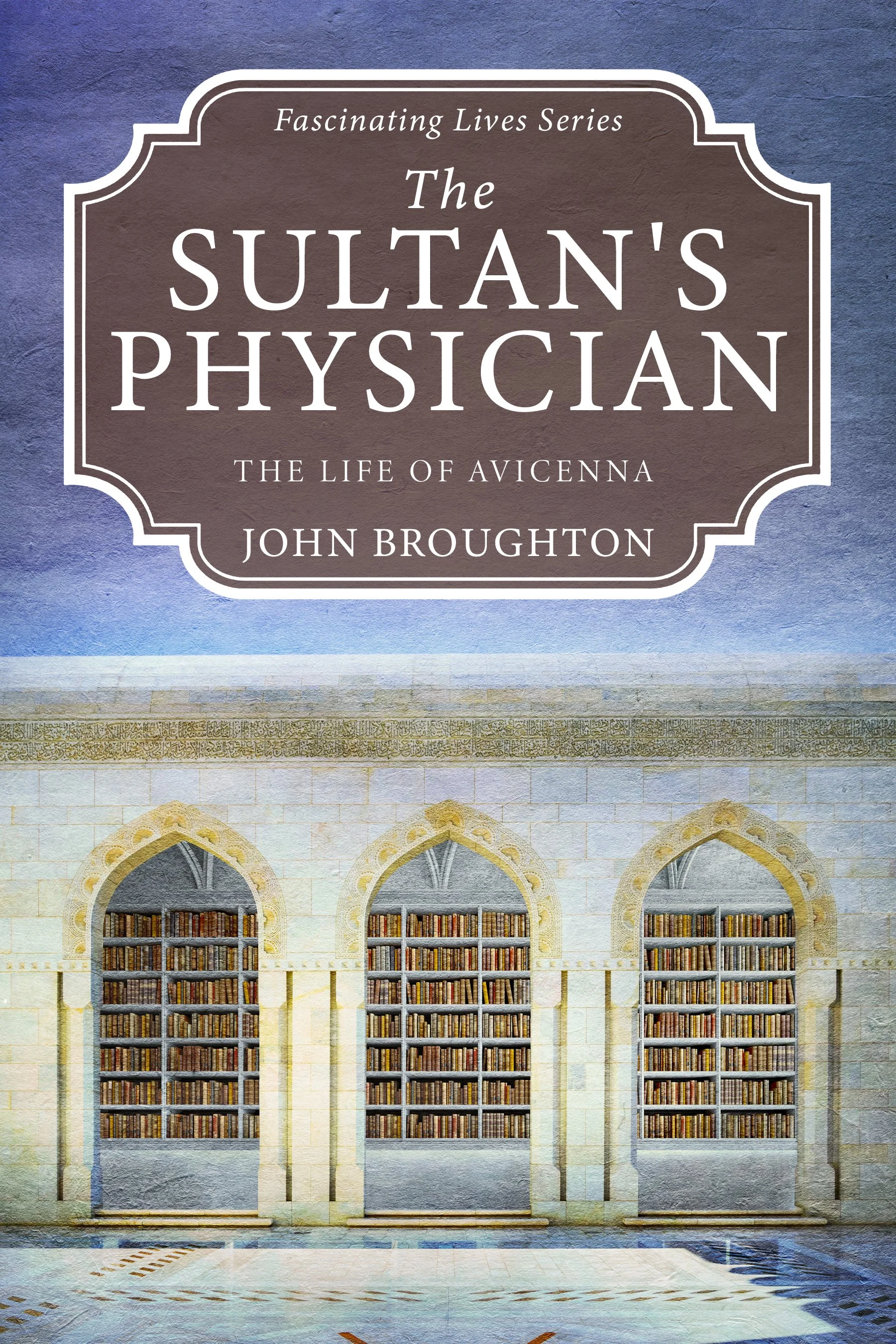
The Sultan's Physician (Fascinating Lives Series)
The Sultan’s Physician
Born with a mind that astonishes scholars and rulers alike, Avicenna rises from prodigy to celebrated physician after saving the life of a dying emir. His reward is access to a forbidden royal library, where knowledge opens the door to both greatness and danger.
As political upheaval drives him from court to court, Avicenna travels with his loyal student al-Jūzjānī, treating rulers, prisoners, and ordinary people while questioning the traditions that shape medicine, power, and faith. Through exile, imprisonment, rivalry, and illness, he refines a radical belief: that body, mind, and soul cannot be understood apart from one another.
In Isfahan, under rare intellectual freedom and alongside the gifted scholar Laylā, Avicenna begins shaping the work that will become The Canon of Medicine. But brilliance makes enemies, and his pursuit of truth carries a cost.
The Sultan’s Physician is a richly woven historical novel about one of the world’s greatest thinkers, exploring medicine, philosophy, ambition, love, and the courage to live with uncertainty.
Discover the story of Avicenna, the physician whose ideas helped reshape the world.
Excerpt from the book
The courtyard of the madrasa was still cool, still innocent, when the argument shattered it.
Old Master Faraj struck the ground with his cane hard enough to snap a dry leaf in two.
“Explain yourself,” he demanded, jabbing the cane towards the smallest figure in the circle. “Explain how you dare speak of impossibility. At your age.”
Husayn ibn Abdullah—eleven years old—was like a young willow tree, bending but not breaking under pressure, his eyes sharp and unyielding like a freshly cut piece of obsidian. He did not cower. The other boys shifted uneasily around him, but he stood as though the air itself offered him a steadying hand. He kept his palms pressed together behind his back, fingernails digging into the delicate skin until it smarted. “It is not a matter of age,” he said. “It is a matter of proof.”
A few students sucked in their breath. The master’s eyebrow rose—a dangerous twitch.
Husayn knelt and carved a square swiftly into the dust. “If this side is one,” he said, “the diagonal is the square root of two. And the square root of two—”
Faraj’s cane smacked the stick out of Husayn’s hand.
“You insolent child!”
The courtyard fell silent except for the flutter of a pigeon above. Husayn’s cheeks coloured, but he held the master’s gaze, unblinking.
“I do not mean insult,” he said softly. “Only truth.”
Somewhere behind them, a door creaked. Husayn’s father stood in the shadows of the portico, arms crossed tightly over his chest. A scholar and tax collector, he understood the price of genius almost as well as he feared it.
Master Faraj’s voice lowered, turning cold. “If you insist on humiliating your elders, Ibn Sīnā, then one day you will find none willing to teach you.”
Husayn’s throat constricted, but he managed, “Then I will teach myself.”
A ripple went through the students. What was this? A challenge, a prophecy, or a warning?
Faraj spun on his heel and stormed off, robes flaring behind him. One by one, the students followed, casting terrified or admiring glances at the boy who had just defied a man three times his age.
The courtyard emptied. Husayn remained kneeling beside the rough square in the dust.
The sun broke over the domes of Bukhara, and for a moment its light caught in the boy’s eyes, revealing something sharp and restless—brilliance, yes, but also a strange, almost dangerous hunger.
His father approached slowly. “You make life difficult,” he murmured.
Husayn rose to his feet. “If they are wrong—”
“That does not matter,” his father snapped, louder than he intended. He lowered his voice. “This world does not bow to truth, Husayn. It bows to power.”
“But knowledge is power.”
“Not for a boy,” his father said, “surrounded by grown men with egos like fragile glass.”
Husayn looked past him into the brightening courtyard. His jaw tightened. “Then I will learn how to walk among them without cutting myself.”
Sed purus sem, scelerisque ac rhoncus eget, porttitor nec odio. Lorem ipsum dolor sit amet.