



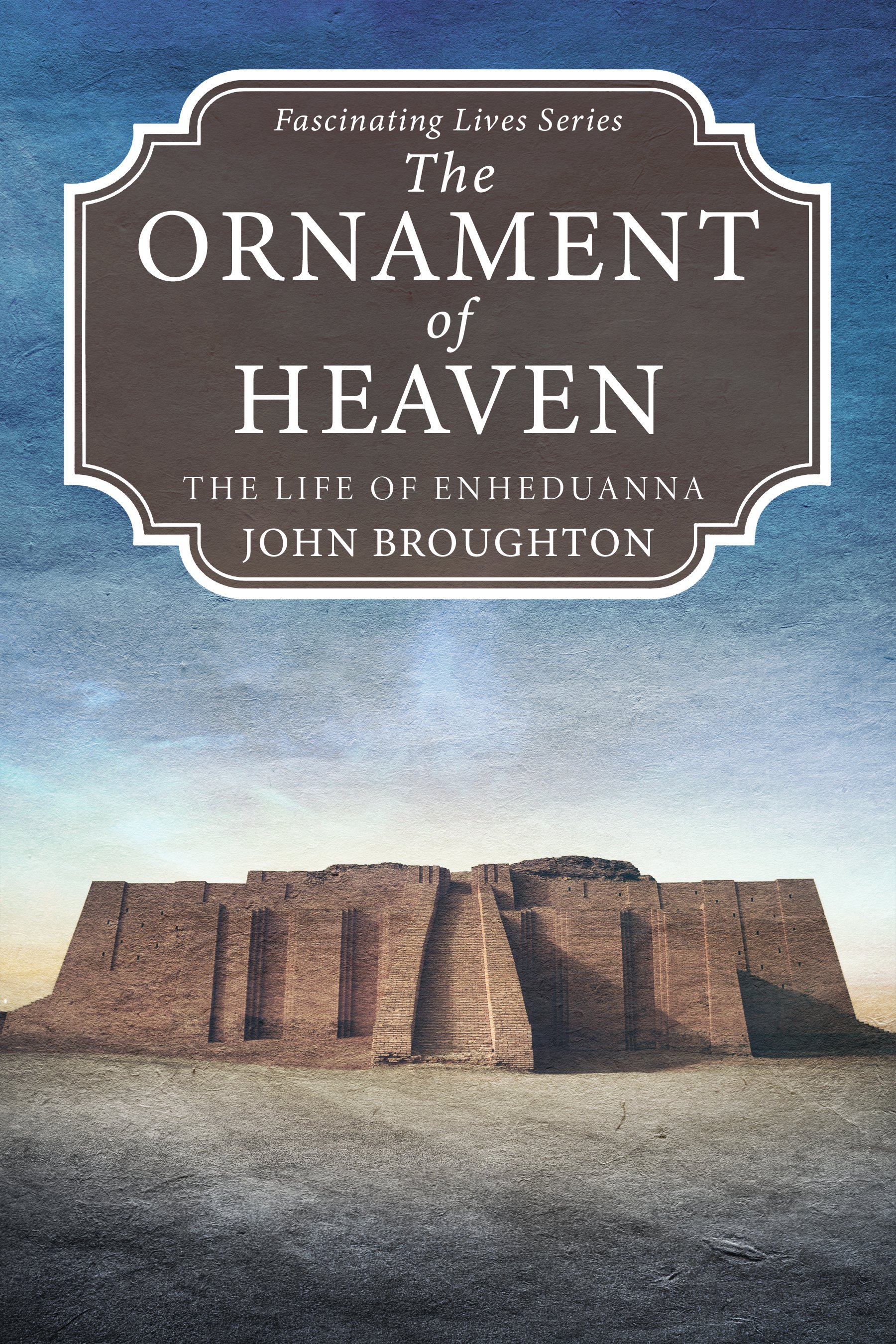
The Ornament of Heaven (Fascinating Lives Series)
The First Known Author in History — and the Woman Who Wrote Herself Into It
Four thousand years ago, in ancient Mesopotamia, Enheduanna became high priestess of Ur, daughter of Sargon the Great, and the first known author in history to sign her work with her own name. When rebellion strips her of power and drives her into exile, she turns to the one thing that cannot be taken from her: her voice. Through hymns to the goddess Inanna, Enheduanna transforms loss, faith, and defiance into words that will outlive kings and empires.
Discover The Ornament of Heaven, a 70,000-word historical novel inspired by the extraordinary life of Enheduanna and the birth of literature, identity, and authorship more than four millennia ago.
Excerpt from the book
The night wind carried dust through the streets of Kish, wailing along the mud-brick walls of the palace like restless spirits. Torches sputtered in their bronze brackets, while beyond the palace gates, a mule whinnied and carts creaked over the rutted road from the market quarter. Donkeys brayed in the outer courtyards, stamping against the cold. From the far side of the walls came the clatter of a late-arriving merchant, his wagon’s wheels carving deep ruts as they lurched over the uneven stones of the southern gate road. Above it all, a distant, almost unplaceable sound—the high, wordless chanting of those who tended the night-fires in the temples—threaded through the din. Kish, a city of thirty thousand, slept fitfully, if it slept at all.
At the heart of the palace, in a chamber lined with painted reeds and thick carpets from the eastern coast, Tashlultum laboured. The heat inside was intense, as if the chamber itself were a kiln and she the clay vessel being fired. The air was syrup-thick with incense: myrrh and cedar, frankincense and a hint of sweet rushes harvested from the marshes. Wet towels steamed at the windows; the midwives glistened with sweat, their hair braided away from faces set in lines of concentration.
“Breathe, my lady,” said the eldest, a woman whose arms were corded like a soldier’s and whose eyes never left the swelling of Tashlultum’s belly. “In and out, and again. Again… good.”
Tashlultum gripped the knotted strip of wool with both hands, beads of saliva on her lips as she bore down through the latest contraction. She had not screamed—not even at the start, when the pains first gripped her and she had to be helped onto the birthing stool—but now a deep, guttural moan began to rise in her chest. A younger midwife, not much older than Tashlultum herself, pressed warm oil along her brow while another woman murmured prayers to the goddess of birth.
“Great Ninhursag, Lady of the Mountain… guide the child safely into the world.”
Tashlultum’s dark hair clung to her temples. Despite the pain, she was present enough to hear parts of the prayer:
“May the river of birth flow gently, may the clay vessel not shatter, may the child see light and not darkness, may the blood be offered to you in thanks, O great mother.”
Her vision blurred. The blue and black patterns of the carpet below shifted, seeming to ripple like water. She remembered, distantly, the view from the roof-gardens of Uruk: the white and gold of the temple, the pale expanse of the river beyond, the yellow clouds of dust kicked up by teams of oxen. Even the pain could not erase the memory of her home. She was a princess, first-born of Uruk’s king, and before she was Sargon’s wife, she had been courted by every heir in Sumer. Yet here, in Kish, the city of her husband—a man whose ambitions reached far beyond its gates—she laboured alone.


Sed purus sem, scelerisque ac rhoncus eget, porttitor nec odio. Lorem ipsum dolor sit amet.