



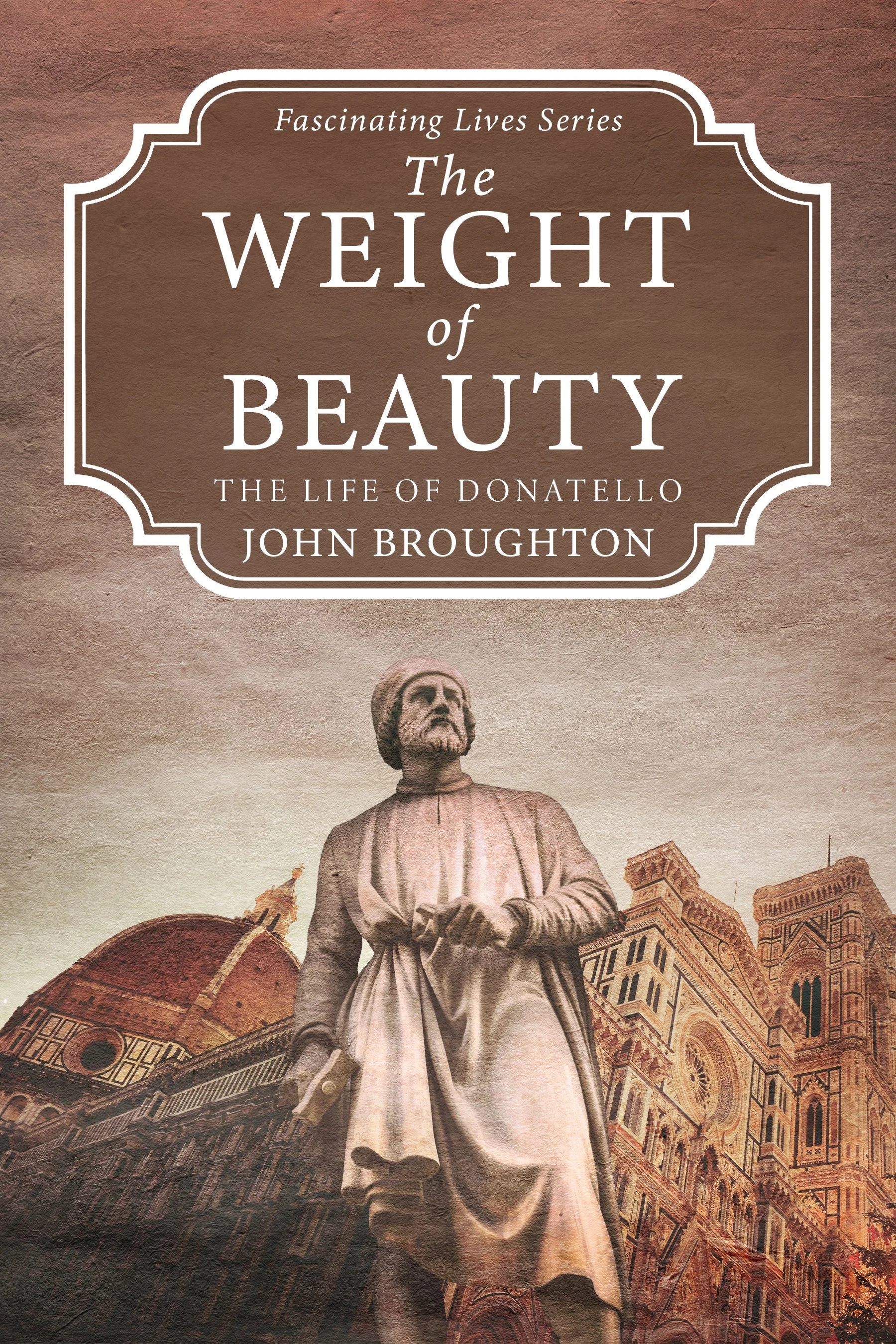
The Weight of Beauty (Fascinating Lives Series)
A Novel of Donatello and the Birth of the Renaissance
Florence, 1415. In a dim tavern, three young artists—Donatello, Brunelleschi, and Masaccio—argue deep into the night, shaping ideas that will redefine how the world sees art. At the center stands Donatello: a sculptor driven not by approval or wealth, but by an uncompromising belief in truth. His figures breathe, doubt, and bleed with humanity, challenging the authority of Church and tradition alike.
As rivalries sharpen and patrons demand obedience, Donatello’s work grows more daring. From scandalous saints to revolutionary monuments, his art captures life as it is—imperfect, fragile, and real. Told through the eyes of those who admire and fear him, The Weight of Beauty traces a relentless pursuit of vision, where creativity carries both power and consequence.
Set against the political and cultural upheaval of early Renaissance Florence, this historical novel explores the cost of conviction and the enduring question: what is the price of seeing the world truthfully—and refusing to look away?
Discover The Weight of Beauty and step into the moment art changed forever.
Excerpt from the book
San Zeno Cathedral, Pistoia, Tuscany 1402 AD
The nave of San Zeno, the cathedral of Pistoia, stretched, bathed in shallow pools of late-afternoon light, the altar silverwork illuminated as if by the gaze of God Himself. Filippo Brunelleschi’s chisel entered the precious metal with a percussion as measured and inevitable as a heartbeat, each tap a syllable in the slow composition of genius. Fourteen-year-old Donato—called Donatello only by close friends and the apprentices who envied him—stood adjacent, his own hands coaxing the beginnings of a figure from flatness. He was slight of build, his fingers elegant and long, his eyes the bright, sharp blue of a Tuscan sky after rain. Filippo’s presence was a sort of shield, a buffer against the world. The boy felt it always, even when Filippo was silent or irritable—which was often.
The cathedral was their crucible. Its cavernous geometry turned every ping of metal into a volley of echoes. The two of them worked here by special dispensation, a privilege paid for in florins and in the currency of their patron’s favour. Every morning, as they passed beneath the archways, Donatello wondered if today might be the day they’d be denied entry and set upon by the rivals who circled their every innovation. For now, though, the space belonged to them: the distant haze of incense, the sawdust underfoot, the slow accumulation of silver figures along the altar.
Donatello’s mind churned as his hands worked. The prophet’s face had given him trouble for hours—Moses, his brow furrowed in the instant before a miracle. He wanted to show the strain of revelation, the crumbling of certainty. The night before, Donatello had dreamed of the prophet’s mouth moving in speech, but the words had been lost in the wind. He tried now to recall the shape of those lips, to see them not as an artisan but as a witness, a soul.
He glanced up at Filippo, who was examining the curve of a chalice. The craftsman’s features were severe, almost ascetic; only in the hours of midnight labour did he permit himself the gentleness of a smile. Donatello, still at the age where sorrow was an abstraction, adored Filippo with a devotion that was part filial, part competitive, and largely companionship based on mutual respect and reciprocal artistic stimulation.
“I’ve set the eyes too close,” Donatello said, mostly to himself.
Filippo grunted, not looking up. “The prophet’s vision is not of the world. Let them sit oddly. It will trouble those who see it.” His voice was gravelled, worn smooth by recent years in the workrooms and the alleys of Florence.
Donatello nodded, and for a while they laboured in silence. The city beyond the cathedral walls pulsed with its usual restlessness: mule carts on the narrow streets, the shouts of vendors and apprentices, the grinding of millstones. The world was moving, but here, in their suspended gleam, the only clock was the measured abrasion of metal.

Sed purus sem, scelerisque ac rhoncus eget, porttitor nec odio. Lorem ipsum dolor sit amet.